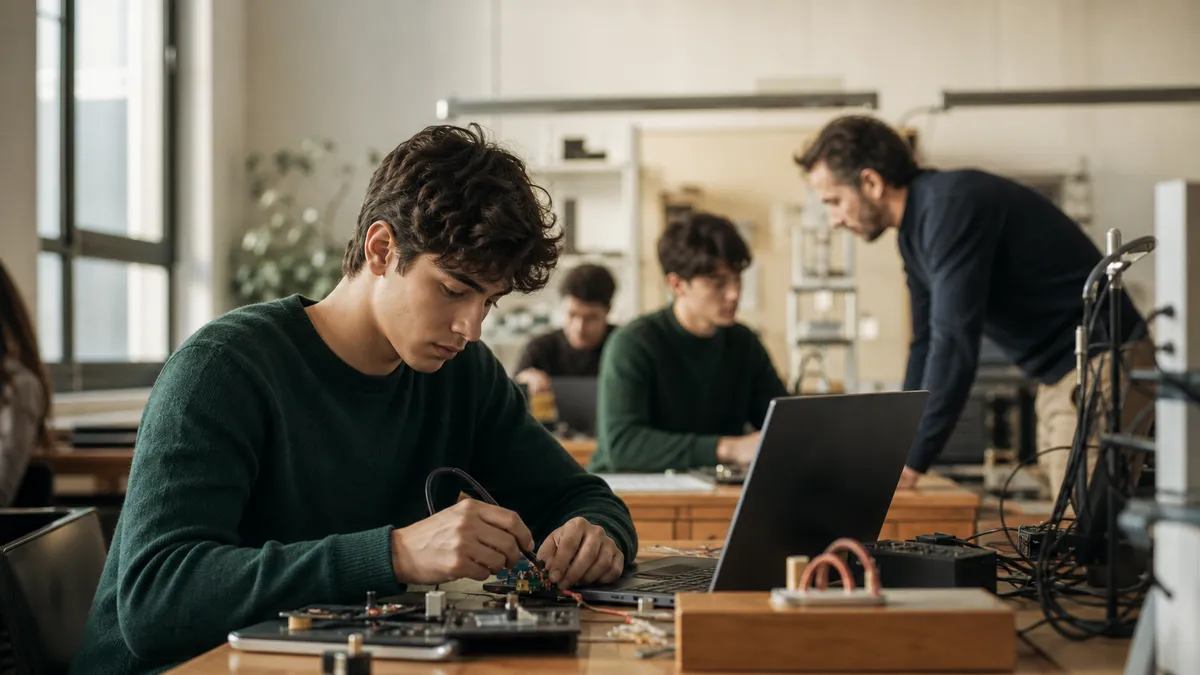
The2026 technical institutes reformis not just an update of timetables and syllabi: for teachers it means rethinking planning, labs, assessment, and guidance in a more integrated way. In this scenario,artificial intelligence in schools 2026can become a concrete ally, if used with clear criteria: it supports personalization, speeds up the preparation of materials, and makes remediation and enrichment more sustainable. In this article you’ll find practical guidance and ready-to-use examples, with a focus on how tools likeStudierAIcan help you prepare the new classes and stay consistent with the new framework.
What changes with the 2026/27 technical institutes reform (in practice, for teachers)
Operationally, the reform pushes toward an approach more oriented toskills, interdisciplinarity, and hands-on lab work. Thenew technical institutes curriculatend to make planning more flexible, with greater attention to expected outcomes, authentic tasks, and links with the local area. For teachers, the immediate impact shows up in four points: (1) distribution of hours among subjects and modules, (2) the weight of labs and project activities, (3) co-planning across areas (scientific-technological, linguistic, economic), (4) leaner but more targeted documentation (UDAs, rubrics, evidence).
Concretely, it’s worth starting from a department map: which core foundations remain unchanged, which content needs updating, which transversal skills (problem solving, technical communication, safety, quality) become explicit. Flexibility works if it is governed: define a few shared indicators and then leave room for differentiated pathways by track and class.
Quick checklist for starting the year with the reform:
- Re-read the goals and expected skills and turn them into 6–10 “observable outcomes” per period.
- Plan at least one interdisciplinary project work per term, with roles and deliverables.
- Make lab hours explicit: objectives, safety, tools, evidence to collect.
- Align tests and assessment with skills (not only content).
Teaching planning and assessment: how to redesign UDAs, tests, and STEM skills
With the reform,teachers’ instructional planningbecomes more effective if it starts from real tasks and works back to the content. A practical model is: (1) target competence, (2) problem situation, (3) products/evidence, (4) required knowledge and skills, (5) activities and labs, (6) rubrics and criteria. This way STEM teaching doesn’t remain a label, but a way of working: data, experiments, prototypes, iterations, and technical communication.
Example (adaptable to various tracks) forSTEM teaching in upper secondary school: UDA “Energy monitoring of a classroom.” Authentic task: measure consumption and propose improvement measures. Evidence: technical report, data sheet, presentation with cost/benefit estimate, sensor prototype or simulation. Subjects involved: mathematics (statistics), physics/electrotechnics (measurements), computer science (data acquisition), economics (cost analysis).
For assessment, use a lean rubric (4 levels) with stable criteria:technical accuracy,method(procedures, safety, traceability),product qualityandcommunication. The assessments can alternate: mini-tests on prerequisites (quick), guided practical tests, and a final authentic task with a clear brief and criteria shared in advance. This reduces disputes and makes the shift from content to skills transparent.
Artificial intelligence at school in 2026: responsible integration in the classroom and in the lab
AI in the classroom works when it is treated as aprocess tool, not as a shortcut to the final product. From anartificial intelligence in schools 2026perspective, define a simple, repeatable policy: what is allowed, what must be disclosed, what is forbidden. And above all: which “human” evidence you collect (drafts, lab logs, oral questioning, technical discussions) to verify understanding and responsibility.
Practical guide in 5 moves:
- “Constrained” prompts: ask for solutions explained step by step, with assumptions and plausibility checks.
- Double submission: first draft with AI (declared), critical revision without AI or with a verification checklist.
- Inclusion: use AI to simplify texts, generate graded examples, support SEN/SLD without lowering objectives.
- Privacy: avoid personal data; use fictional cases; keep only necessary work; clarify timelines and purposes.
- Assessment: separate “support” (allowed) from “performance” (oral exam, practical test, project discussion).
Activity examples: error analysis (AI proposes a deliberately imperfect solution and the class corrects it), generating test cases for a program, preparing questions for a technical interview, or simulating a client who requests specifications and constraints. In the lab, AI can help translate requirements into operational checklists and draft reports, but measurement and validation remain central and observable.
Guidance and alignment with ITS/University/industry: pathways, project work, and marketable skills

technical school guidancebecomes truly effective when it is integrated into teaching, not relegated to sporadic meetings. The reform pushes to make exit skills explicit and connect them to concrete outcomes: ITS, professionalizing universities, apprenticeships, local supply chains. For teachers this means designing experiences that “look like” work: roles, constraints, timelines, quality, safety, documentation.
Three high-impact strategies:
- Project work with a client: a company or organization proposes a real problem (even simplified) and the class delivers a prototype or a technical report.
- Internal micro-credentials: badges or certificates of specific skills (e.g., lab safety, versioning, reading datasheets) linked to shared rubrics.
- Guidance portfolio: each student collects evidence (reports, prototype photos, reflections) and links it to professional roles and post-diploma pathways.
This approach also helps motivation: students understand “what it’s for” and see a continuous thread across subjects. Moreover, it makes it easier to document marketable skills, useful both for the exam and for applications to internships and ITS pathways.
How StudierAI supports teachers and classes in the 2026 reform: summaries, flashcards, quizzes, planners, and oral simulations

With heterogeneous classes and curricula more oriented to skills, the challenge is to makepersonalization, frequent checking, and remediationsustainable. In this,StudierAIcan become practical support to align daily study with the reform’s goals, without losing instructional control. The idea is not to “delegate” to AI, but to use useful automations to free up time for labs, tutoring, and feedback.
Examples of classroom use (and why they work with the new framework):
- Targeted summaries: to prepare pre-lab and post-lab, focusing on procedures, risks, and key concepts (useful for safety and quality).
- Flashcards and spaced review: great for STEM prerequisites (units of measure, formulas, technical definitions) and for students with memorization difficulties.
- Quizzes and formative checks: questions with increasing difficulty, with immediate feedback; useful for monitoring skills before the authentic task.
- Study planner: supports autonomy and workload management, reducing disengagement and helping ongoing remediation.
- Oral simulations: train technical vocabulary, reasoning, and the ability to justify design choices (consistent with rubrics and skills).
To start simply: choose a short unit, define 10–15 key concepts, and have students create a set of flashcards and a self-assessment quiz. Then use the results to form remediation/enrichment groups and arrive at the lab with stronger prerequisites. If you want to test the approach right away, you canstart for freeand evaluate the impact on just one class before extending it to the department.
Finally, to share a common vision on tools and method (and understand how responsible-use principles are handled), it may also be useful to consult theabout uspage and align classroom choices with school priorities: transparency, inclusion, privacy, and the centrality of the lab.
