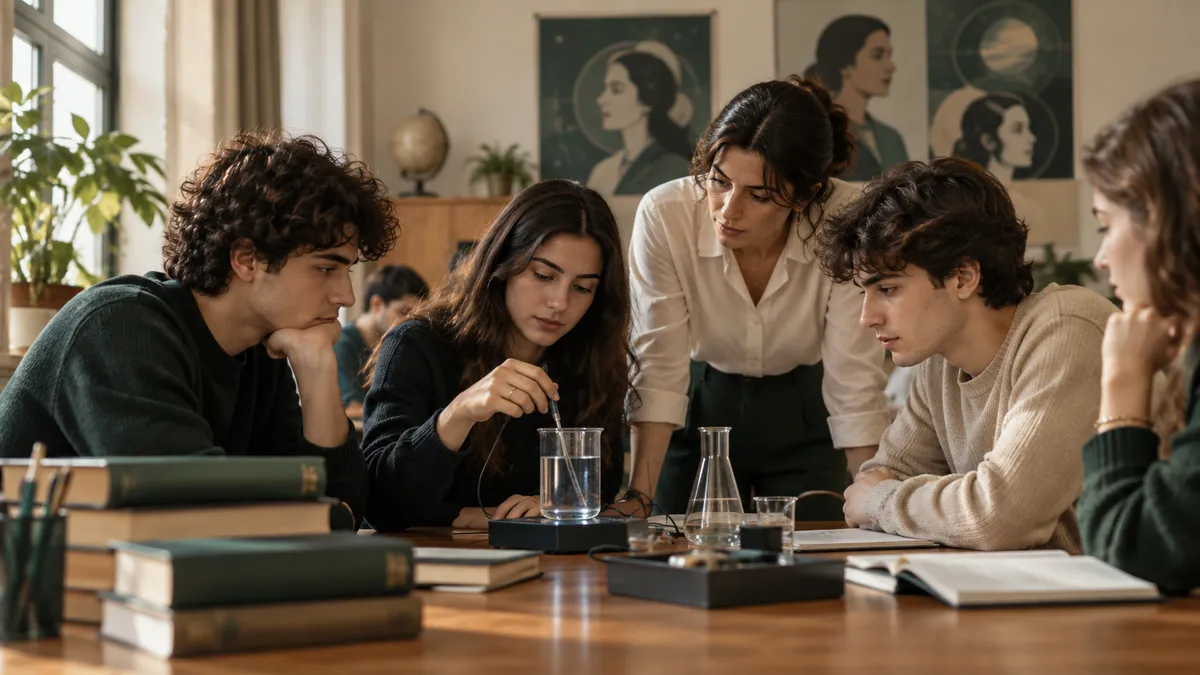
The “Cerchiamo scienziate” competition is a national educational competition that invites lower and upper secondary schools (Italian *scuola secondaria di I grado* and *II grado*—roughly, middle school and high school; both state-run and state-recognised private schools) to design and produce research and communication projects about women in science, to promote STEAM in schools and support educational guidance. The deadline for submitting projects is set for30 April 2027: here you’ll find an operational guide for teachers with objectives, documents to read, a calendar, and a ready-to-adapt teaching pathway for your class.
Many SERP results simply republish the notice or circular (dates, requirements, link to the PDF). Here we go one step further: how to turn the Cerchiamo scienziate competition into an assessable, interdisciplinary learning unit that fits school time constraints, with pedagogical evidence on motivation, inclusion, and scientific citizenship skills.
“Cerchiamo scienziate” competition: objectives, target participants, and why to propose it in class
The “Cerchiamo scienziate” competition was created with a clear purpose: to highlightwomen in scienceand strengthen interest in STEAM subjects at school through research, reworking, and communication activities. It is aimed atlower and upper secondary schools (Italian *scuola secondaria di I grado* and *II grado*)(state-run and state-recognised private schools) and works well both with whole classes and with project groups (PCTO—Italian school-to-work pathways, enrichment activities, after-school labs, guidance/orientation pathways).
From a teaching perspective, the added value is the combination of three levers that educational research identifies as effective for engagement:authentic learning(a real product with an external audience),identification(role models and diverse narratives), andinterdisciplinarity(science + Italian language/literature + history + technology + civics). In terms of skills, a well-designed pathway develops: source-based research, critical thinking, scientific literacy, effective communication, collaboration, project management, and awareness of gender stereotypes.
In terms ofeducational guidance (Italian *orientamento scolastico*, i.e., support for study and career choices)the competition is particularly useful because it lets you work on two dimensions: (1) knowledge of professions and study pathways connected to scientific research; (2) self-efficacy (“I can do it too”), especially when female students see examples of possible, non-linear careers. In class, this translates into guiding questions, interviews, mini-research tasks, and metacognitive reflections—not just a “creative assignment.”
Official call and documents: where to find them and what to read to avoid mistakes
To avoid formal errors (which often weigh more than the project’s quality), it’s best to start from the official documents. Typically, the call and the accompanying note can be found on: the website of theMIM (Italian Ministry of Education and Merit), the pages of theRegional School Offices (Italian *Uffici Scolastici Regionali*, USR)and communications from lead schools or local networks. If you only find a “summary” circular, always look for the linked original PDF: that’s where project types, formats, consent forms, and submission procedures are defined.
How to read the call like a “teacher coordinator” without getting lost: print (or note down) a checklist and verify each point. The critical steps—often underestimated in calls—are these:
- Participants and categories: school level, any separate sections (lower secondary / upper secondary), individual or group participation, maximum number of entries per school.
- Project types and formats: maximum length for videos/podcasts, page limits, allowed file formats, image resolution, any required templates.
- Assessment criteria: which dimensions count most (research rigour, originality, communicative clarity, educational impact, correctness of sources). Align your class rubric with these criteria.
- Consent forms and privacy: permissions for images/video of minors, use of music or protected materials, guidance on personal data. Prepare forms and collect signatures in advance.
- Submission method: platform or email, file naming, folders, deadlines “by … o’clock,” receipt confirmation. This is where the most frequent mistakes happen.
An organisational tip: formally appoint ateacher coordinator (Italian *docente referente*)(even if the project is interdisciplinary) and define clear responsibilities: collecting consent forms, checking sources and copyright, format control, final submission, archiving. This makes the project “replicable” over the years and not dependent on a single person.
What are the deadlines for the “Cerchiamo scienziate” competition?
Circulars and news posts list dates in a concise way; for teaching planning, however, you need to turn them into a “staff-meeting-ready” calendar (Italian *consiglio di classe*, the class council/teaching team). Based on official communications, the key dates are:
- Competition launch: publication of the call and opening of participation (the date indicated in the call/MIM note is the authoritative one).
- Possible intermediate windows: some editions require registration, nomination of the coordinator, or progressive uploads. Check whether a preliminary step is required.
- Submission/projects:30 April 2027(reference deadline for submission).
To reach the deadline without last-week crunch, backward planning in 5 stages works well (adaptable to 6–10 weeks of work):
- T-8/10 weeks: present the competition, choose the topic and the scientist, define groups and roles (research, writing, fact-checking, media production).
- T-6/8 weeks: research using reliable sources, build a bibliography/webography, collect quotations and verifiable data; first outline draft of the project.
- T-4/6 weeks: production (writing, storyboard, filming, prototype), peer review, and check against the call’s criteria.
- T-2/4 weeks: polishing, copyright and consent-form checks, final editing, file compression/optimisation, naming check.
- T-1 week: test submission (if possible), final submission, receipt confirmation, and documentation archiving.
How to take part in the “Cerchiamo scienziate” competition: teaching pathway, outputs, and interdisciplinary assessment
To make the competition a realteaching project(and not a “little craft”), it’s worth structuring a phased pathway with assessable intermediate outputs. This reduces performance anxiety, improves quality, and makes assessment criteria transparent.
1) Select the scientist and define the research question. Avoid purely “celebratory” choices: the question must be investigable. Examples: what institutional obstacles did she face? What methods did she use? What is the impact of her discoveries today? Link it to a civics topic (access to education, research ethics, inequalities) or to a contemporary issue (health, climate, technology).
2) Source research and information literacy. Here you work on key skills: distinguishing primary/secondary sources, checking authority, date, bias, triangulating information. Set a simple rule: every “strong” claim (data, award, discovery, quotation) must have a traceable source. This step is also crucial to counter stereotypes: online biographies often simplify or omit contexts and collaborations.
3) Design the output (backward design). Start from the call’s criteria and define: audience, key message, supporting evidence, final format. Allowed output types vary by edition (argumentative text, multimedia presentation, video, podcast, scientific poster, digital product). Whatever the choice, require an intermediate submission: outline + bibliography + draft introduction. This is where you prevent “copied” or overly generic work.
4) Production and revision. Organise revision in two rounds: (a) peer review with a checklist (clarity, coherence, sources, compliance with limits); (b) teacher review focused on rigour and accuracy. This phase is also great for working on Italian language skills: cohesion, register, synthesis, quotations, paraphrase. If the output is multimedia, make roles and responsibilities explicit to prevent “tech” from overshadowing content.
5) Interdisciplinary assessment and guidance-oriented feedback. Assessment works when it’s transparent: a rubric with 4–5 dimensions, shared before you start. An example of rubrics “compatible” with calls of this kind:
- Research quality: variety and reliability of sources, correctness of citations, data accuracy.
- Scientific understanding: explanation of concepts/methods, appropriate use of disciplinary language, ability to connect discoveries and impacts.
- Communication: structure, clarity, message effectiveness, narrative/argumentative quality, suitability for the audience.
- Collaboration and project management: roles, meeting deadlines, documentation of the process (logbook).
- Guidance and civic reflection: awareness of stereotypes/obstacles, connections to study pathways and professions, ethical/social implications.
For guidance, close the pathway with a brief reflection: “what did I discover about myself while working on this project?” and “which STEAM skills did I actually use?”. It’s a simple way to make learning visible and connect it to future pathways, without turning the competition into an end-in-itself contest.
Tools and support: how StudierAI can help teachers and students with research and writing
To make the work sustainable (especially with multiple classes or groups), you need support that helps manage research, writing, and revision without lowering standards.StudierAI for teacherscan be useful as a “planning assistant” to set clear assignments, rubrics, and timelines, and to guide students in producing coherent, verifiable texts. If you want to explore the platform, you can start fromStudierAIorstart for freeand try it out with a single activity (for example, building the outline or the rubric).
Here are some concrete uses, consistent with a professional approach and with typical requirements in the call (always to be checked against the official document):
- Guided brainstorming: generate a list of women scientists by discipline (physics, computer science, medicine, chemistry, Earth sciences) and possible research questions, avoiding overly generic topics.
- Outlines and assignments: turn the call into operational tasks (what to submit, in what format, with which criteria) and into micro-deadlines for groups.
- Source summaries: help students summarise articles and biographies, distinguishing facts, interpretations, and historical-scientific context; useful for building an annotated bibliography.
- Language revision and coherence: check clarity, cohesion, register, repetitions; improve introduction and conclusion without distorting students’ voice.
- Rubrics and assessment: create rubrics aligned with the competition criteria and subject-specific competencies; also useful for shared assessment among teachers from different departments.
Note: any support tool (AI included) should be used with a simple, transparent teaching rule:traceabilityof sources and process. Ask students to also submit a short logbook (what we did, which sources we used, what we changed after revision). This protects originality, reduces the risk of “plausible but inaccurate texts,” and makes it easier to demonstrate the work’s quality if questions arise.
If you’re designing a broader pathway on STEAM in schools, women in science, and educational guidance, you can also explore other resources on ourblogand integrate the competition into an annual plan (for example: one project per term/semester with progressive outputs and a final presentation open to the school community).
In short, the Cerchiamo scienziate competition works best when it’s treated as a research pathway with intermediate deliverables, explicit criteria, and a guidance-oriented wrap-up. Start from the call, plan backwards toward 30 April 2027, and build a final product that shows rigour, sources, and the ability to communicate science: that’s exactly what Google can’t give you with a simple circular, but what makes the difference in the classroom.
