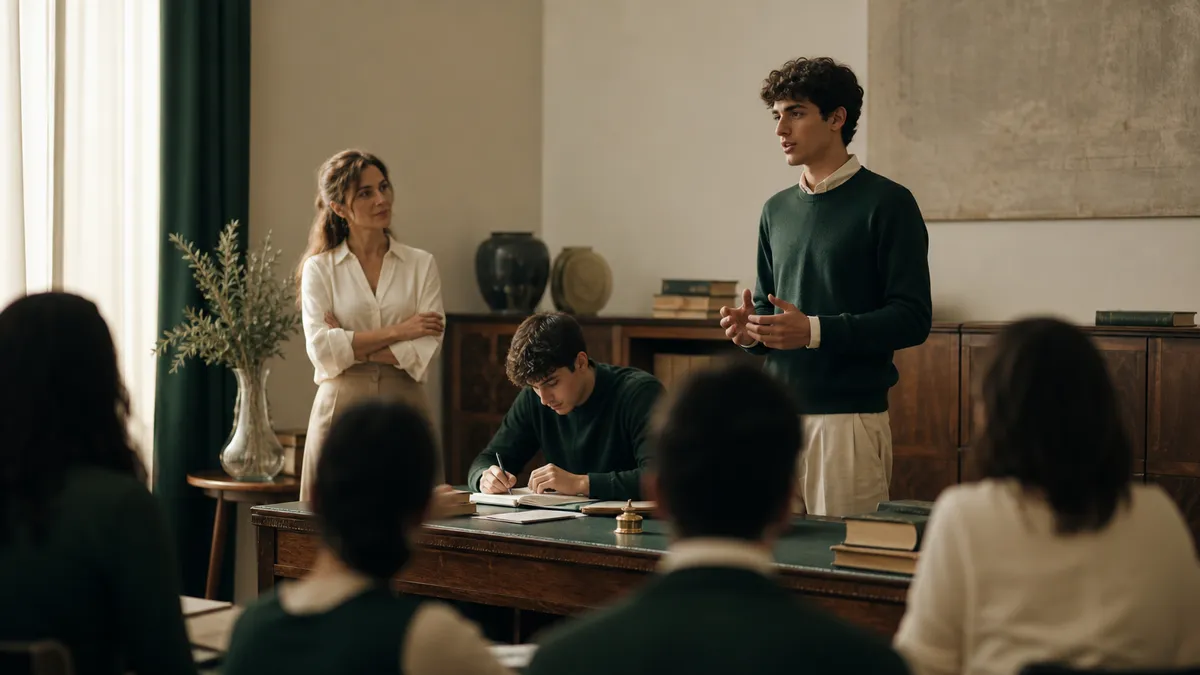
In oral exams, the quality of the content is essential, but increasingly it is not enough: the same answer can come across as clear and convincing or, instead, confused and fragile depending on how it is communicated. From the perspective oforal preparation 2026, for teachers and students it becomes strategic to train communicative competence in a broad sense: voice management, posture, gaze, pauses, rhythm, presence. This article explains howStudierAIintegrates the analysis ofnon-verbal languageintooral exam simulationsand proposes concrete teaching strategies to bring these tools into the classroom, with observable rubrics and measurable objectives.
Why non-verbal language becomes decisive in oral exams 2026
In today’s oral exams, assessment tends to integrate subject knowledge and transversal skills: the ability to argue, organize a discourse, respond to unexpected questions, stay on track, manage anxiety. In this framework,non-verbal communicationis not an “extra”: it is part of the performance. A monotonous tone can make content seem poorly mastered; a closed posture can communicate insecurity; poorly managed pauses can break the coherence of a line of reasoning. Conversely, varied prosody, a sustainable pace, and functional gestures help the listener follow, remember, and attribute credibility.
From a pedagogical point of view, the centrality of the non-verbal connects to three pieces of evidence useful for instructional design: (1) effective learning requiresdeliberate practicewith timely feedback; (2) oral performance improves when the student has explicit criteria (rubrics) and micro-goals; (3) reducing performance anxiety also comes from predictable routines and progressive simulations, which make the assessment context familiar. In other words: it’s not enough to “review,” you need to train the way you present.
For teachers, this means being able to observe and guide two intertwined dimensions: the correctness and depth of the content, and the ability to make it accessible to an interlocutor. When the oral exam becomes an authentic communication situation, the quality of the task and the assessment improves: the student understands that the goal is not “to say everything,” butto build a comprehensible and sustainable discoursewithin the given time, with non-verbal signals consistent with the communicative intention.
What to observe: the main non-verbal indicators in an oral simulation
To make the non-verbal trainable, it helps to break it down into observable indicators. In an oral simulation, especially if oriented toward transparent assessment criteria, it is useful to distinguish between vocal signals (more easily measurable) and bodily signals (more contextual, but equally important). Below is an essential map, with typical errors and good practices that can be transferred into a rubric.
- Prosody (intonation and variation): a typical error is monotony that “flattens” the discourse; a good practice is to use variation to signal logical steps (definition, example, conclusion).
- Pace and speed: speaking too fast reduces comprehension and increases stumbling; too slowly can make the discourse lose cohesion. Good practice: a medium pace with controlled accelerations in details and slowdowns on key concepts.
- Pauses: a typical error is filled pauses (“um,” “like”) or random pauses that break syntax. Good practice: intentional pauses before a key point or between two topics, as a structural signal.
- Volume and articulation: a voice that is too low or poorly articulated is interpreted as uncertainty or poor preparation. Good practice: vocal projection appropriate to the classroom and clear articulation, especially on technical terms.
- Eye contact: a typical error is staring at the desk/ceiling or “getting stuck” on one point. Good practice: alternate gaze between the interlocutor and mental notes, with a micro-scan of the class if the oral exam is public.
- Facial expressions: inconsistency between content and face (e.g., a nervous smile on serious concepts) can be distracting. Good practice: a neutral-engaged expression, with signals of attention when listening to the question.
- Gestures: repetitive gestures (pen, hands intertwined) or excessive gestures steal attention. Good practice: illustrative gestures that accompany enumerations, comparisons, cause/effect, without exceeding the “frame” of the torso.
- Posture and orientation: closed shoulders, shifting weight, or a body “ready to flee” communicate tension. Good practice: stable feet, open shoulders, torso oriented toward the interlocutor, functional micro-movements (e.g., a change of position between two parts of the discourse).
These indicators become pedagogically powerful when they are linked to observable behaviors and effects on comprehension. In a rubric, for example, “appropriate pace” can be translated into descriptors such as: maintains complete sentences without running out of breath; inserts pauses between concepts; avoids fillers beyond a threshold. The advantage is twofold: the student knows what to train and the teacher can justify the judgment with shared criteria, reducing the perception of arbitrariness.
How StudierAI integrates non-verbal analysis into oral simulations
An effective simulation is not just “asking questions”: it is creating a short cycle of performance–feedback–repetition, in which the student understands what to change already on the next attempt. Inoral exam simulationson StudierAI, attention to the non-verbal focuses on what is most trainable and reliably observable: above all vocal signals and behavioral indicators linked to managing the interaction (turn-taking, pauses, fillers, fluency). The goal is not to “standardize” students, but to provide a common language to improve communicative delivery with the same content.
The typical workflow can be presented to teachers as a replicable routine: (1) choosing the topic and difficulty level; (2) simulation with progressive questions; (3) feedback return; (4) targeted repetition on one or two objectives. If you want to contextualize the pedagogical approach, you can also consult theabout ussection, useful for understanding the instructional design philosophy and the focus on guided practice.
On the operational level, integrating non-verbal analysis happens in three complementary ways:
- Vocal indicators: pace, pause duration, frequency of fillers, regularity of speech, clarity of articulation. These signals are useful because they often correlate with comprehensibility and anxiety management.
- Structure of the presentation: opening (defining the topic), development (argumentation and examples), closing (summary and connections). This too is “non-verbal” in a functional sense: structure manifests through pauses, intonation, and discourse markers.
- Action-oriented feedback: not only “you were clear/not clear,” but suggestions that can be turned into short tasks (e.g., insert a 1–2 second pause before the definition; reduce fillers by replacing them with silence; highlight three keywords with intonation).
For teachers, the central didactic point ismeasurability: when the student receives feedback they can verify in the next attempt, self-efficacy increases and dependence on external judgment decreases. For example, working on “fewer fillers” or “more regular pauses” is more concrete than “speak better.” In addition, guided repetition fosters generalization: what is acquired in simulation tends to transfer to the real oral exam because training happens under similar conditions (questions, time, pressure).
If you are considering using it in class or as homework, you can have students try a first simulation independently and then discuss in class the strategies that emerged. To explore the tool:sign up for freeorstart for freeand set a simple goal: a 2-minute answer with an introduction, two arguments, and a final summary, taking care of pace and pauses.
Teaching strategies for teachers: using simulations to train global communication

Integrating the non-verbal dimension does not require “extra hours”: it works best with frequent micro-activities and stable criteria. Below are four proposals that adapt to different subjects and that leverage simulations as a communication gym, not as a simple test.
1) 90–120 second micro-simulations (weekly routine). Each week choose a fixed format: “define–exemplify–connect.” The student answers in a short time, then immediately repeats a second time applying just one non-verbal improvement (e.g., a pause before the definition). This approach is inspired bydeliberate practice: small goal, immediate feedback, repetition.
2) Guided peer feedback with a two-column rubric. Hand out a simple rubric with two areas:content(accuracy, examples, connections) andnon-verbal language(pace, pauses, eye contact, posture). Each peer must write: one observable strength and one suggestion phrased as an action (“Insert a pause before the conclusion”). The teacher models 2–3 examples on the board, then lets pairs work. Result: more objective feedback and a more cooperative classroom climate.
3) Weekly goals “one at a time.” To avoid overload, choose just one non-verbal indicator per week for the whole class (e.g., fillers; pace; pauses). Work with a logic ofprogression: first comprehensibility (volume, articulation), then structure (pauses and discourse markers), and finally presence (gaze, posture). The class perceives that “improving” is a process and not an innate talent.
4) Progress monitoring with double evidence: product and process. For the product, assess disciplinary quality; for the process, monitor 1–2 communicative indicators. An effective method is the “improvement sheet” that the student fills out after each simulation: what worked, what they will change in the next attempt, which strategy they will use (e.g., breathing, outline, pauses). This reinforces metacognition and makes preparation for oral exams more solid.
One last note: make it explicit that the goal is not to “recite,” but to communicate effectively and in a way that respects the context. Coherence between content and non-verbal signals is what supports authority and comprehension. In this perspective, tools such asStudierAIcan become support to make practice more frequent and feedback clearer, without replacing the teacher’s role: they enhance it, because they free up time to work on argumentation, subject-specific vocabulary, and the quality of thinking.
Bringing non-verbal analysis into simulations means, in practice, transforming the oral exam from a “one-off” event into a pathway. For oral preparation 2026, this approach helps students face the exam with greater control: they know what to say, but above all they know how to say it. And for teachers it offers a fairer and more formative observation grid, capable of valuing growth over time, not only performance on the day.