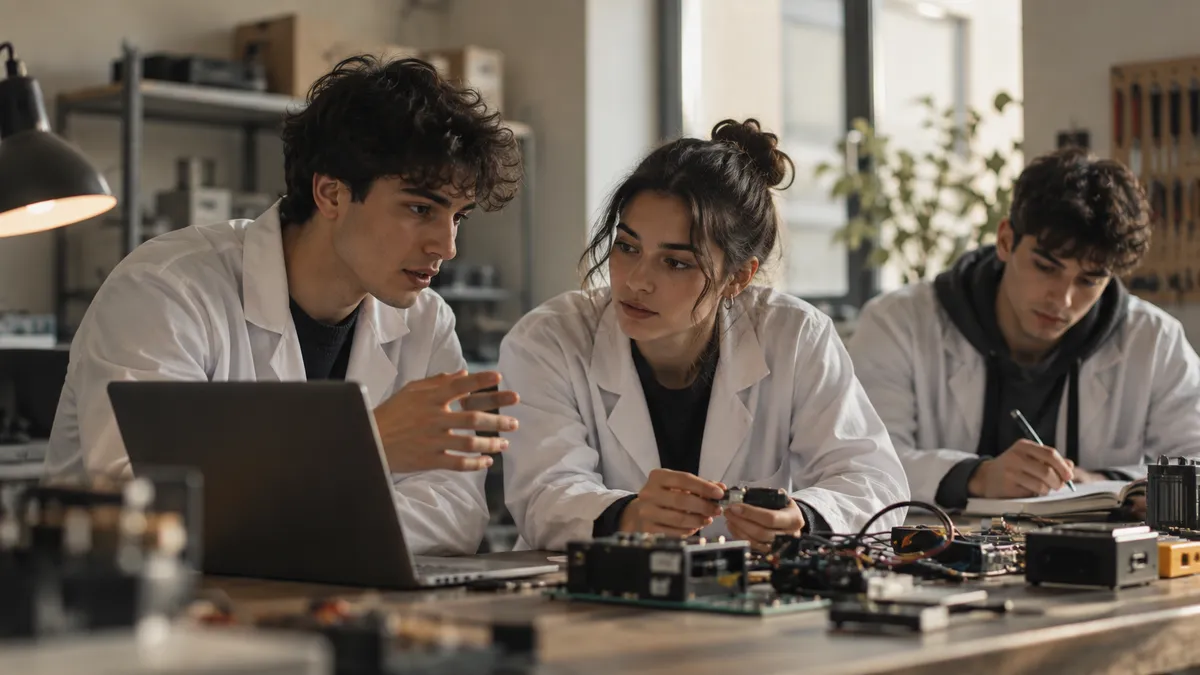
Thetechnical education reformcomes into effect gradually starting from the 2026/2027 school year (a.s., *anno scolastico*; starting with first-year classes) and aims to make technical institutes more closely connected to work, digital skills, and labs. For you, in practice, it means less “memorising for the oral test” (*interrogazione*, the Italian in-class oral questioning) and more project-based assessments, real-world tasks, anddigital skillsthat end up being part of grading and oral exams.
If you’re looking for “what really changes,” I get it: online you often find the “brochure” version. Here we’ll put it plainly: what you might actually see in class, how oral tests andexam preparationchange, and why everyone keeps mentioningITS Academyas if they were the “DLC” of the diploma.
do
who we are.and not just ofknowing. Not “less theory,” but theory that has to hold up when you apply it: if it collapses the moment you touch an exercise or a real case, it’s not worth much.
The most visible changes (and the ones that also change how you study) revolve around four things:
- More STEM and more “real problems”: not just formulas, but decisions (which tool do I use? why? what margin of error do I accept?).
- More technical English and more CLIL (Content and Language Integrated Learning): reading documentation, procedures, manuals, and being able to explain a process in English too (at least at a basic “lab-level”).
- Labs and real-world tasks: assessments that look like mini-projects (fault diagnosis, a measurement report, simulating a job order, a prototype).
- More “competency-based” assessment: not just the final result, but also the process (how you get there, what choices you make, how you document it).
A hallway example: before, it might have been enough to memorise two pages on “networks and protocols” and get by in the oral test (*interrogazione*). With a competency-based approach, the question becomes: “You’ve got a network that’s slow in the lab:how do you test it, what hypotheses do you make, what data do you collect, and how do you explain it so a teacher/technician can follow you?” It’s a mindset shift: from “I repeat” to “I think out loud.”
When it comes into force and for whom: timelines, gradual rollout, and what to expect
The thing that creates the most confusion is “from when.” The reform startsin the 2026/2027 school year (a.s., *anno scolastico*) for first-year classesand then extends progressively to the following years. So it’s not like tomorrow morning everything changes for everyone in exactly the same way.
If you’re already in upper secondary school when it starts, you might see a mix: some “new-style” activities arrive earlier (projects, grading rubrics, more lab work), while the full structure settles in as the new first-year cohorts move up each year.
For those who are post-diploma (*diploma*, the Italian upper secondary school qualification), the big piece is the link with the technical pathway and withITS Academy: the idea is to make the transition between technical institutes and tertiary professional training more “linear,” with more consistent skills (digital, lab, project-based work).
What to realistically expect, without anxiety:
- More “hybrid” tests: a written part + a practical part + two oral reasoning questions.
- More documentation: write-ups, reports, short presentations (done properly too, not “two slides thrown together”).
- More demands for autonomy: choosing a method, justifying it, and assessing what you could have done better (self-assessment).
How grading, oral tests, and oral exams will change in technical institutes

Here comes the part you actually care about if you’re thinking about your next *interrogazione* (in-class oral questioning):oral exams(and oral tests) tend to shift from “tell me the definition” to “explain how you would use it.” It’s not philosophy: it’s a real change in the criteria you’re assessed on.
Three things that may count more:
- The process: how you set up the work, how you check for errors, how you correct if something doesn’t add up.
- Communication: being able to walk through a project in 2–3 minutes without getting lost (a workplace skill, but also an oral-test skill).
- “Practical” digital skills: using tools, interpreting data, troubleshooting, documenting well (tidy files, naming conventions, versions).
Examples of “new-style” questions that sound realistic in a technical institute:
- Computer science: “You have a slow database: which indexes would you check and why? What tests do you run to understand whether the problem is the query or the hardware?”
- Electronics: “You need to measure a noisy signal: which instrument do you choose, how do you set up the measurement, what errors do you expect?”
- Mechanics: “You have a tolerance out of spec: how do you identify it, what causes do you hypothesise, what do you change in the process?”
Note well: it doesn’t mean “if you’re shy, you’re screwed.” It means it’s worth training like you train for a sport: micro-simulations, short repetitions, feedback.exam preparationbecomes less “a marathon the night before” and more “distributed training.”
What are ITS Academy Foundations (and what does it mean for your post‑diploma future)?
TheITS Academyare tertiary (post‑diploma) programmes designed to train you in a very hands-on way for technical profiles companies are looking for: automation, cybersecurity, data, mechatronics, energy, logistics, and so on. “Foundations” because they bring together schools, institutions, local areas, and companies: it’s not just classroom theory, it’s also lab work and often a serious internship (*stage*, internship/placement).
Why do they matter for the technical education reform? Because if the post‑diploma pathway demands certain things (projects, tools, standards, technical English), it’s normal that technical institutes “before that” start pushing those foundations too. In practice: what today is “extra” (documenting work properly, presenting a project, using digital tools with judgement) tomorrow may become the norm.
A concrete example: if in an ITS automation programme they ask you to submit a clear, repeatable test report, it’s likely that already in technical school you’ll be graded better if you can produce a clean write-up, with data, justified choices, and a conclusion that isn’t just “we did it, that’s it.”
So the useful question isn’t only “ITS yes or no?”, but: “Am I building a profile that holds up in a practical context?” The reform, for better or worse, pushes you in that direction.
How to prepare right away: study method, digital skills, and how StudierAI can help you
If school is moving toward more practical tests and more “reasoned” oral assessments, yourstudy methodhas to do the same. You don’t need to study twice as much: you need to study so that, when they ask “ok, so what?”, you already have a structured answer.
Here’s a strategy that really works (tested in real life: homework, buses, surprise tests).
1) Turn every topic into “input → process → output”
When you study something (a physics law, a protocol, a machine), always write three lines:
- Input: what do I start with? Data, conditions, tools.
- Process: what do I do, what choices do I make, what checks do I put in place.
- Output: what do I get and how do I know it’s “good.”
This framework is gold for oral tests and oral exams: it keeps you from rambling and makes you sound immediately like “someone who knows what they’re doing.”
2) Active review: 20 minutes worth more than 2 hours
Instead of rereading, do this: close your notebook and try to explain the topic out loud as if you had 90 seconds. Then reopen it and fix the gaps. It’s simple, but it’s the most direct way to train for oral assessment and actually make it stick.
If you want to do it with a guided structure, you can use theoral exam simulationto practise answering “teacher-style” questions and to keep your thread when they interrupt you or change the angle of the question (it always happens).
3) Minimal portfolio: keep track of projects (even small ones)
If assessment is moving toward “real-world tasks,” you need material to review from: an organised folder with write-ups, photos of the setup (without faces if you prefer), troubleshooting notes, conclusions. It doesn’t have to be a masterpiece: it has to be something that lets you say “I did this and I can explain it.”
4) Digital skills: pick 2 abilities and bring them to a “usable” level
“Digital skills” doesn’t mean knowing everything. It means having two things you can use well and can demonstrate. Practical examples (pick two based on your track): spreadsheets for data analysis, basic scripting, reading logs, file versioning, technical documentation, effective research using reliable sources. When the teacher asks “how do you verify it?”, you already have the tools.
5) Targeted training for orals: awkward questions + examples
Prepare 10 “awkward” questions for each chapter: “when doesn’t it work?”, “what are common mistakes?”, “what alternative is there?”, “what happens if this condition changes?”. And for each answer, add an example of your own (even invented, but realistic). That’s how you move from “I know the definitions” to “I can reason.”
Where doesStudierAIfit into all this? The idea is to use it as a “training partner” to make studying more practical: review plans, quizzes to immediately see what you don’t know, flashcards to lock things in, and simulations so you don’t walk into the oral assessment cold. If you want to try it with no commitment, you canstart for free.
One last thing (peer to peer): the reform may seem like “far-off stuff,” but its real effect is that it rewards those who canexplainanddo, not just those who “remember.” If you start training now with a study method that’s more oriented toward real problems, when the rules really change you’ll already be ahead. If you feel like also understanding the project’s philosophy and why we’re building it this way, there’s the pagewho we are.
