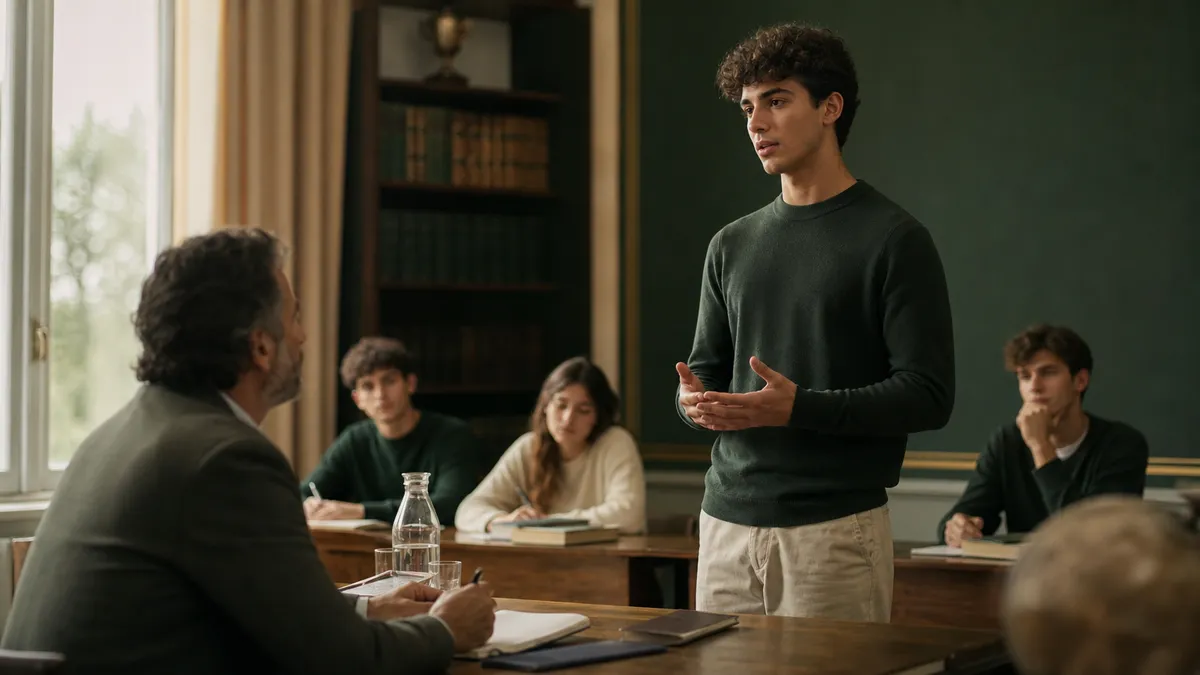
In recent years, the oral exam has become less and less a “recital” of content and more and more a test of thinking: understanding a prompt, selecting relevant information, arguing coherently, and connecting knowledge. For teachers, this means rethinking classroom training: repeating isn’t enough; we need to build transferable skills. In this scenario, tools ofartificial intelligence studycan support already solid teaching practices (simulations, rubrics, feedback) by making them more frequent and personalized. In this article we propose an operational framework for tacklingsurprise questionsin oral exams, with a focus on how theStudierAI Exam Simulationcan integrate into preparation fororal exams 2026and forhigh school final exam preparation. If you want to explore the tool right away, you can check outStudierAIandstart for freeto see how a guided simulation works.
Why in 2026 surprise questions matter more in oral exams
The trend in oral exams (especially in the context of the high school final exam and end-of-cycle assessments) is clear: more and more, what is assessed is the ability toA skill that is often overlooked is what to do when a piece is missing. Teach legitimate phrases and cognitive moves: ask for clarification, narrow the scope (“I can answer by considering…”), start from a known case and work back to the concept, state uncertainty without collapsing (“I don’t remember the exact date, but I place the event in…”). This doesn’t lower the bar: it makes metacognition observable and reduces the paralysis effect., not just to reproduce memorized content. This shift responds to a pedagogical and equity need: distinguishing those who have understood and can transfer, from those who have learned in a purely declarative way. In 2026, with students used to retrieving information quickly, the difference is made by the quality of processes: selection, organization, inference, argumentation.
TheThe practices described work best when they become regular: many short presentations, rapid feedback, progression in difficulty. Here AI can be an organizational accelerator, not a substitute for the teacher. TheStudierAI Exam Simulation
oral exams 2026, this kind of training can support continuity between individual study and school assessment criteria.(such as clarifying the question, asking for clarification, giving an example, building an argument in 60–90 seconds). The oral exam, in fact, is also a test of disciplinary communication: vocabulary, structure, pace, use of evidence and references.
What makes an “unexpected” question difficult: skills, typical mistakes, and signals to observe
An unexpected question is difficult when it requires quickly activating multiple skills at the same time. It’s not just “I didn’t study it”: often it’s “I don’t know how to orient myself.” From a teaching perspective, we can break performance down into observable abilities, also useful for building rubrics and feedback.
Skills involved (with examples of indicators):
- Understanding the prompt: rephrases the question in their own words, identifies constraints (time, scope, author, period), distinguishes between “define” and “argue.”
- Retrieval and selection: chooses 2–3 central concepts instead of listing everything; avoids digressions; uses relevant examples.
- Organizing the discourse: introduces a thesis or guiding idea, develops in a logical sequence, closes with a summary or consequences.
- Argumentation and use of evidence: cites a datum, a text passage, an experiment, a formal definition; distinguishes opinion from justification.
- sign up for free
- about us
Typical mistakes we see in oral exams, which the unexpected amplifies:
- To close with a practical criterion: good preparation for surprise questions is not measured by the number of questions “guessed,” but by the quality of the strategies the student brings into play when the question changes. If in class we make these strategies explicit (rubric, micro-simulations, links to constraints) and support them with tools that increase practice frequency, the oral exam becomes fairer and more formative. It’s a key step in guiding students toward solid, usable high school final exam preparation—not only to pass the exam, but to learn to think and communicate under constraints.
- Excess of definitions: repeats formulas or “textbook” phrases without applying them to a case, a text, or a problem.
- Forced connections: shifts to “safe” but irrelevant topics, reducing the quality of reasoning.
- Stress blocks: prolonged silence, voice dropping, interrupted sentences; often it’s not “not knowing,” but not having a retrieval strategy.
Observable signals useful for teachers (formative lens): when the student makes a mistake, let’s ask whether the error is one of knowledge (content missing), access (can’t retrieve it in time), organization (can’t structure), or communication (knows it but can’t express it). This distinction guides targeted interventions: review, recall exercises, scaffolding outlines, short-exposure practice.
Teaching methodologies to train rapid responses without sacrificing depth

Training responses to the unexpected does not mean rewarding speed for its own sake. The goal is to builduseful cognitive automatisms: understanding the prompt, planning an answer, arguing, and checking coherence. Below are some methodologies applicable in class (and adaptable to any subject).
1) Structured Socratic questioning (3 levels)
Build a sequence of questions that goes from clarification to justification, up to implications. Cross-disciplinary example: “What does X mean?” → “What evidence supports X?” → “What would change if X were not true?” This training develops depth, but in a dialogic and progressive form. Operational tip: give students a “set” of argumentative connectors (because, therefore, however, in particular) and assess their conscious use.
2) Constraint-based connection maps
Don’t ask for generic maps. Set constraints that simulate the unexpected: “Connect this concept to an author, a historical event, and a contemporary example” or “Find two analogies and one difference.” Constraints force selection and justification of connections, avoiding random associations. It’s a powerful practice even for students with strong knowledge but weak organization.
3) High-frequency micro-simulations (2–4 minutes)
Instead of a single long oral test, propose micro-turns: unexpected question, 20 seconds of silent planning, 60–90 second answer, immediate feedback. Frequency reduces anxiety (gradual exposure effect) and makes progress visible. Variants: “answer with a mandatory example,” “answer with a counterargument,” “answer with a final one-sentence summary.”
4) Light (but explicit) rubrics for the oral exam
An effective rubric for surprise questions doesn’t have to be long: 4 criteria with clear descriptors are enough. For example: (a) understanding the question, (b) disciplinary accuracy, (c) structure and coherence, (d) examples/connections. Sharing the rubric before simulations increases transparency and improves self-regulation: students know what to observe and how to improve.
5) “Recovery” strategies when you don’t know
A skill that is often overlooked is what to do when a piece is missing. Teach legitimate phrases and cognitive moves: ask for clarification, narrow the scope (“I can answer by considering…”), start from a known case and work back to the concept, state uncertainty without collapsing (“I don’t remember the exact date, but I place the event in…”). This doesn’t lower the bar: it makes metacognition observable and reduces the paralysis effect.
How StudierAI uses artificial intelligence to simulate oral tests and surprise questions

The practices described work best when they become regular: many short presentations, rapid feedback, progression in difficulty. Here AI can be an organizational accelerator, not a substitute for the teacher. TheStudierAI Exam Simulationis designed to reproduce the logic of an oral test: it generates questions, adapts the level, and returns suggestions for improvement. Looking aheadoral exams 2026, this kind of training can support continuity between individual study and school assessment criteria.
What does a good AI-based simulation do, concretely, from a teaching perspective?
- It varies prompts and introduces controlled surprises: not only “explain X,” but also “compare,” “apply to a case,” “find a counterexample,” “connect to Y.” This is where surprise questions become trainable.
- It adapts difficulty: if the student answers well, it raises the demand (more constraints, more connections, more precision); if they struggle, it offers scaffolding (hints, sub-questions, reminders of prerequisite concepts).
- It provides process-oriented feedback: not only “right/wrong,” but guidance on structure, relevance, use of examples, clarity, and argumentative coherence.
- It makes practice sustainable: it enables many short attempts, reducing organizational load and increasing consistency (a crucial element for high school final exam preparation).
For a teacher, the added value is not “delegating assessment,” but obtaining a context of guided practice between one lesson and the next. You can, for example, assign a micro-simulation as homework: 5 minutes of answering variable questions, with a clear instruction (“bring to class 3 recurring errors you noticed in the feedback and one strategy to correct them”). In this way AI supports self-assessment and frees up class time for high-quality work: discussion, clarifications, deepening, authentic exercises.
In addition, the simulation can be used to explicitly train the “moves” against freezing: the student practices rephrasing the question, asking for a constraint, building an answer in three steps (thesis–evidence–conclusion). This is particularly useful when the goal is to overcome the effect “unexpected question = panic,” turning it into “unexpected question = procedure.”
If you want students to experience a gradual pathway of simulations, you can invite them tosign up for freeand, to learn about the project’s educational approach and context, consult the pageabout us.
To close with a practical criterion: good preparation for surprise questions is not measured by the number of questions “guessed,” but by the quality of the strategies the student brings into play when the question changes. If in class we make these strategies explicit (rubric, micro-simulations, links to constraints) and support them with tools that increase practice frequency, the oral exam becomes fairer and more formative. It’s a key step in guiding students toward solid, usable high school final exam preparation—not only to pass the exam, but to learn to think and communicate under constraints.