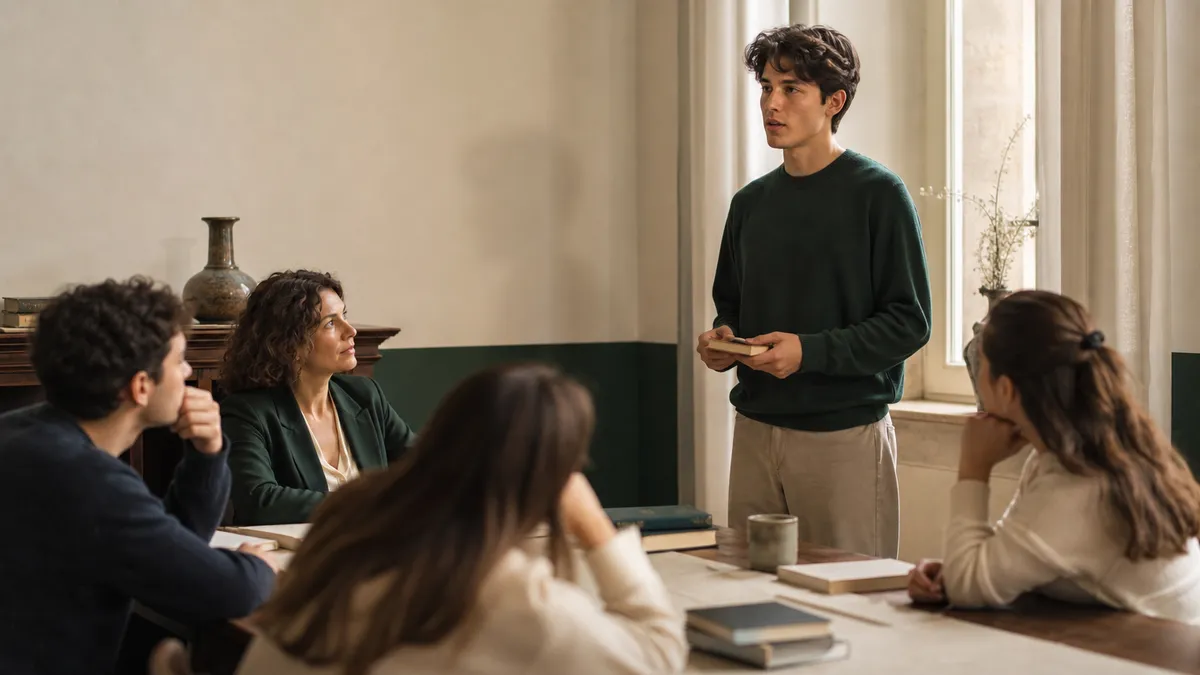
In theoral exam simulationsthe quality of the presentation does not depend only on subject-matter preparation: often it is the ability to withstand a critical question, an objection about the method, or a remark about tone that determines whether the student can stay clear-headed, argue their case, and recover. In view ofpreparation for the 2026 Maturità, trainingemotional intelligencetherefore becomes a concrete teaching objective: it helps students interpret criticism as information, not as threats, and to turn stress into attention. This article proposes an operational method for teachers: map typical critical issues, teach micro-response routines, and use tools likeStudierAIto make simulations repeatable, calibrated, and improvement-oriented. If you want to try it in class or in the lab, you can alsostart for freeand build a progressive training pathway.
Why emotional intelligence is crucial in 2026 oral exam simulations
When a student enters an oral simulation, they bring two “backpacks” with them: one of knowledge and one of internal states. The second often weighs more. Educational and psychological research converges on a point that is useful in practice: under stress, cognitive load increases, working memory decreases, and the ability to plan one’s discourse worsens. In other words, even those who “know” may not manage to “say.”emotional intelligenceStructured response in 3 moves: thesis (one sentence), justification (two reasons), example or connection. It helps those who tend to get lost in the details.
3)Four didactically sound (and easily implementable) uses are as follows:(volume, posture, assertiveness, turn-taking): “Speak more slowly,” “Don’t interrupt,” “You’re not answering the question.” It often triggers shame or anger, because it touches one’s self-image. Reactions: shutting down (lower voice, minimal answers) or counterattacking (“But I…,” “That’s not fair”). Signals: stiffening, nervous smile, defiant or avoiding gaze. Causes: little familiarity with formal contexts, past experiences of being judged, difficulties in emotional regulation.
The way the teacher provides feedback is also crucial. In simulations, the most effective feedback is
From a teaching standpoint, it is worth making a simple idea explicit to students:criticism is data, not a judgment of the person. This framing reduces the perceived threat and makes it more likely that students will use cognitive strategies (arguing, looking for examples, making connections) instead of protective strategies (denying, attacking, shutting down).
Criticism and difficult questions: recurring types and what they trigger in students
and on the tool’s overall setup.can help teachers and students design simulations consistent with the Maturità objectives and work on handling criticism gradually.first requires recognizing the forms criticism takes during an oral questioning or a simulation. A shared map helps teachers give more precise feedback and helps students avoid “personalizing” the event. Below are three recurring types and the typical observable reactions.
1)Content criticism(accuracy, completeness, examples): “This data isn’t correct,” “You’re missing a step,” “What’s the source?” It often triggers fear of “not knowing,” with reactions such as freezing, filler words, topic-jumping. Signals: looking down, increased speed, broken sentences. Common causes: rote study without understanding, little practice with active retrieval, fear of making mistakes.
and build a set of simulations with simple rubrics (content, method, communication, self-regulation). From an educational transparency perspective, it may also be useful to share references and aims of the project with the class council: you can find information onwho we areand on the tool’s overall setup.
3)Four didactically sound (and easily implementable) uses are as follows:(volume, posture, assertiveness, turn-taking): “Speak more slowly,” “Don’t interrupt,” “You’re not answering the question.” It often triggers shame or anger, because it touches one’s self-image. Reactions: shutting down (lower voice, minimal answers) or counterattacking (“But I…,” “That’s not fair”). Signals: stiffening, nervous smile, defiant or avoiding gaze. Causes: little familiarity with formal contexts, past experiences of being judged, difficulties in emotional regulation.
This distinction is useful because it enables targeted feedback: if the issue is methodological, it’s not a matter of “reviewing more,” but of learning how to organize; if it’s about tone, it’s not enough to correct the content, but necessary to train communication and self-regulation skills. Moreover, it helps interpret certain reactions as (clumsy) attempts at protection: defensiveness, freezing, or aggressiveness are often automatic responses to a perceived threat, not conscious choices.
and build a set of simulations with simple rubrics (content, method, communication, self-regulation). From an educational transparency perspective, it may also be useful to share references and aims of the project with the class council: you can find information on
Practical strategies for teachers: teaching emotionally intelligent responses during simulations

Effective strategies share one common feature: they arerepeatable micro-actionsthat reduce impulsivity and increase response quality. To work, they must be taught the way a lab procedure is taught: teacher modeling, guided practice, immediate feedback, repetition in varied contexts. Below is a four-step routine, applicable to any subject.
- can help teachers and students design simulations consistent with the Maturità objectives and work on handling criticism gradually.
- Rephrasing the criticism or question: “If I understand correctly, you’re asking me to…”. It reduces misunderstandings and lowers relational tension.
- Structured response in 3 moves: thesis (one sentence), justification (two reasons), example or connection. It helps those who tend to get lost in the details.
- Assertive closure and openness to improvement: “I can integrate this point better by adding…”. It turns the mistake into a reparative action.
This routine makes a central idea visible:you don’t respond “from the gut”, you respond “in steps.” At first it may seem artificial; after a few sessions it becomes a useful automatism, especially for more anxious students.
Alongside the routine, some specific micro-techniques work well for the most frequent situations:
- When the student freezes: allow a “technical pause” (“Take five seconds and start again from the thesis”). It normalizes regulation without lowering expectations.
- sign up for free
- When the student reacts aggressively: use a clear boundary (“I’m happy to listen, but in a respectful tone”) and then propose a guided rephrasing of the criticism.
The way the teacher provides feedback is also crucial. In simulations, the most effective feedback isGeneration of calibrated critical questions: objections about content, method, and vocabulary, with progressively increasing difficulty levels. This makes it possible to train the emotional response without “throwing the student into the water” on the first attempt.: it describes observable behaviors (“You changed the subject after the objection”), makes the effect explicit (“That way the answer loses coherence”), and proposes a workable alternative (“Try rephrasing the question and then return to the thesis”). This approach reduces humiliation and increases the likelihood that the student will try again.
One last teaching lever: clearly separate two moments. First, the “fluid” simulation (no interruptions, except in extreme cases). Then, the debrief (analysis). This structure protects performance and allows metacognitive analysis: what did I feel? when did tension rise? what strategy did I use? what will I do next time? In this way, emotional intelligence becomes trainable and measurable over time.
How StudierAI supports teachers and students in handling criticism in simulations

who we areand on the tool’s overall setup.can help teachers and students design simulations consistent with the Maturità objectives and work on handling criticism gradually.
Four didactically sound (and easily implementable) uses are as follows:
- Creation of questioning scenarios: the student practices with variable prompts and instructions (subject-specific and interdisciplinary), reducing the “surprise” effect and increasing communicative adaptability.
- Generation of calibrated critical questions: objections about content, method, and vocabulary, with progressively increasing difficulty levels. This makes it possible to train the emotional response without “throwing the student into the water” on the first attempt.
- Feedback on structure and clarity: highlighting whether the answer has a recognizable thesis, whether the reasons are coherent, whether the examples are relevant. This supports the “method” component, which is often the most fragile under pressure.
- Tracking emotional-communicative progress: not to “label” the student, but to monitor practical indicators (number of functional pauses, ability to rephrase, reduction of filler words, turn-taking management). Continuity makes improvement visible and increases self-efficacy.
For teachers, the main advantage is the ability to standardize some conditions of the simulation (time, type of questions, difficulty) and free up energy for what matters most: observing the student, picking up emotional signals, and intervening with respectful feedback. For students, the value is repetition: handling criticism improves not with a “lesson,” but with many controlled exposures, each followed by a micro-goal (“today I practice rephrasing before answering”).
If you would like to start a trial, you cansign up for freeand build a set of simulations with simple rubrics (content, method, communication, self-regulation). From an educational transparency perspective, it may also be useful to share references and aims of the project with the class council: you can find information onwho we areand on the tool’s overall setup.
In summary, working on emotional intelligence and handling criticism is not a soft “extra”: it is an investment in the quality of oral performance and in the student’s maturation as a communicator. Simulations become truly formative when they include: realistic critical issues, response routines, non-humiliating feedback, and progress monitoring. Under these conditions, preparation for the 2026 Maturità can shift from a source of anxiety to a competence-building pathway: knowing how to respond well, even when the question is difficult.