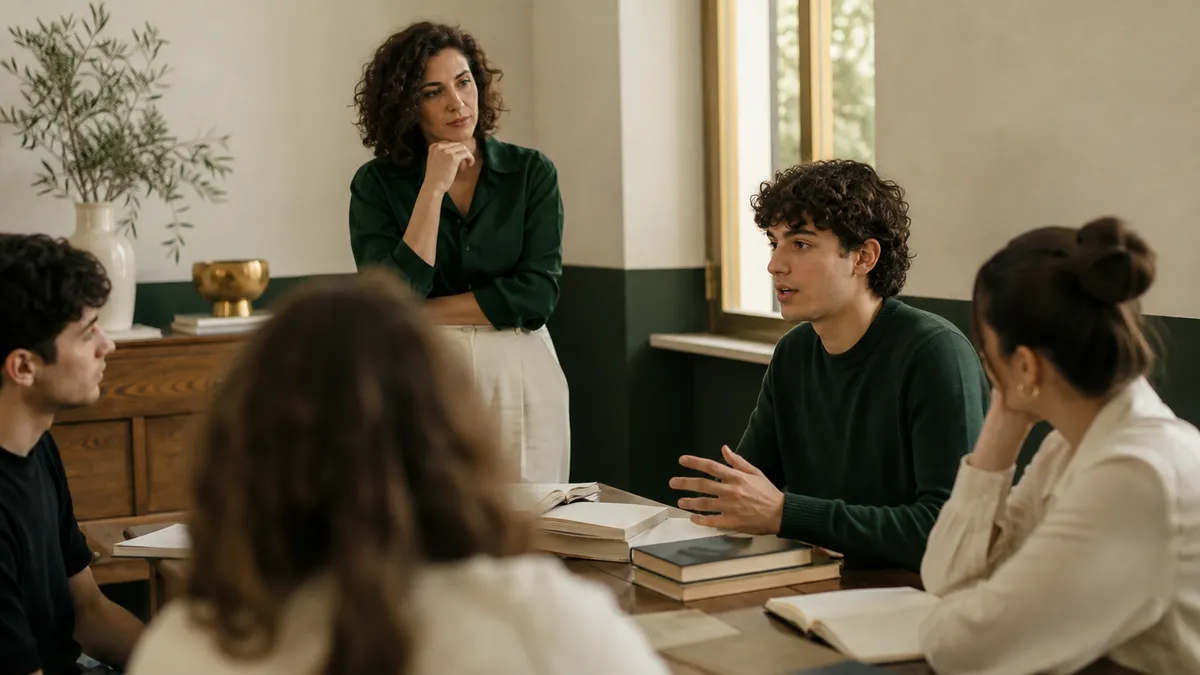
Upper secondary final exam preparation has never been just “reviewing content”: in oral exams, what matters is the ability to argue, make connections, manage time, and answer unexpected questions with confidence. For teachers, this means designing high school oral tests and oral exam simulations that are truly formative, not mere repetitive drills. In this article I present an operational method to personalize study and simulations, and howStudierAIcan support teaching work with adaptive assessments and targeted feedback, keeping clear and inclusive assessment criteria at the center.
start for free
sign up for free
Personalizing oral exam simulations increases effectiveness and confidence because it responds to three well-established pedagogical principles: **deliberate practice** (training specific components with feedback), **cognitive load** (graduating complexity and demands), and **formative assessment** (making progress visible and guiding study choices). In other words, the simulation is not an event but a pathway: you move from “I can say something” to “I can sustain an oral interview” through short, repeated cycles of test–feedback–revision.
Implementation in class and at home: workflow, privacy, inclusion, and results monitoring
To integrate oral exam simulations without overloading the curriculum, you need an essential, repeatable, and sustainable workflow. Below is a concrete proposal (adaptable by subject) that combines in-class and at-home work, maintaining assessment consistency and attention to privacy.
**5-step workflow (weekly cycle)**
Step 1 – Weekly goal (5 min): state 1 presentation skill and 1 content core (e.g., “answer with a thesis + two arguments” on a specific topic).
Step 2 – In-class micro-simulation (10–12 min in pairs): one student presents, the other uses a mini-rubric to note evidence (not judgments). Quick rotation.
Step 3 – At-home practice (15–20 min): personalized oral simulation (with equivalent questions by level) and a brief self-assessment: “what I did well / what I’ll redo tomorrow.”
Step 4 – Teacher feedback (sampling): you don’t need to correct everything. Choose 5–6 students per week (in rotation) and give brief feedback, anchored to the rubric and with one concrete action (“add an example,” “reduce digressions,” “define terms before using them”).
- Step 5 – Monitoring (5 min): update a simple indicator for each student (e.g., “structured answer,” “subject-specific vocabulary,” “time”). After 4 weeks, run a longer simulation to check transfer.
- On **privacy**, the teaching rule is: data minimization and clarity of purpose. Avoid uploading sensitive information; work on goals and competencies, not personal “profiling.” If you collect audio, define retention times and purposes (formative only). If using external tools, check settings, notices, and permissions according to school procedures.
- For **inclusion**, personalization is an advantage if well designed: you can offer temporary supports (outlines, keywords, planning time), alternative ways of responding (short audio, paired presentation before the whole class), and specific attention to language (reduce ambiguity, make instructions explicit). The goal remains shared; the steps to get there change. This approach also reduces performance anxiety: the student perceives a pathway, not a sudden judgment.
Finally, **results monitoring**: choose a few metrics that are observable and consistent with the rubric. Examples: percentage of answers with an explicit thesis; number of relevant examples; reduction of “empty” pauses; ability to finish within the time. After 6–8 weeks, compare two equivalent simulations (same structure, different questions) to measure real improvement and not simple memorization.
If you wish to contextualize the approach and the educational philosophy of the project, you can also consult the page
. In any case, the key remains pedagogical: clear goals, frequent simulations, brief but targeted feedback, and personalization that makes the student more autonomous and more ready to handle an authentic oral interview.
- **Start** (1 min): framing question to check definitions and context.
- **Development** (4–5 min): two questions of increasing difficulty (one applied, one reasoning-based).
- **Connection** (2 min): interdisciplinary bridge or link to a cross-cutting theme (method, citizenship, history of ideas).
- **Closing** (1–2 min): metacognitive prompt (“What is the most important point and why?”) or synthesis (“Summarize in three sentences”).
To differentiate difficulty levels, you can act on four levers: (a) breadth of required content, (b) degree of inference (recall vs application vs evaluation), (c) time constraints, (d) amount of supports (keywords, outline, maps). Example: with the same goal, a “Basic” student may be given 3 keywords and 30 seconds of planning; an “Advanced” student answers without supports and with a final follow-up question (“What objection might you receive?”).
Assessment must remain transparent. An essential rubric (also to be used as feedback) can include 5 indicators with observable descriptors: **subject accuracy**, **completeness**, **argumentative coherence**, **language and register**, **management of the interview** (time, relevance, response to prompts). You don’t need a long rubric: you need a rubric that guides revision. After each simulation, ask the student to identify 1 piece of evidence in favor (“what worked”) and 1 area for improvement (“what I will do differently next time”).
Finally, plan a weekly progression: no more than 2 focuses at a time. Week 1: clarity and structure; week 2: examples and applications; week 3: connections; week 4: handling unexpected questions. This pacing also helps colleagues on the class council coordinate demands and avoid overload.
How StudierAI supports teachers and students: adaptive oral exam simulations and targeted feedback

When time is short and profiles are many, the difficulty is not having “ideas for questions,” but producing coherent, calibrated, and trackable variants. Here tools likeStudierAIcan become a teaching ally, if used within a clear methodological framework: explicit goals, a shared rubric, and action-oriented feedback.
In practice, the support can be structured into four functions useful for final exam preparation and high school oral tests:
- **Generation of personalized assessments**: questions anchored to the syllabus and the profile (e.g., more recall for those with gaps, more connections for those already solid).
- **Variation of prompts and difficulty**: the same competence can be trained with equivalent but not identical questions, reducing the “I memorize the answer” effect.
- **Targeted feedback on content and performance**: beyond correctness, guidance on structure, relevance, vocabulary, completeness, and time management.
- **Progress tracking**: highlighting recurring patterns (typical errors, fragile concepts, improvements in synthesis) to guide study for the following week.
The educational value increases if teachers provide clear constraints: topics, duration, level, criteria. For example, you can request a 7-minute simulation with: 1 definition question, 1 application to a case, 1 interdisciplinary connection. Or you can train “handling the unexpected” by requiring a follow-up question that tests coherence (“If we changed this condition, what happens?”).
To start lightly, you can have students use the tool at home as a “training partner,” while you keep the direction: choose the subject cores, define the rubric, and ask for a brief deliverable (audio or outline). If you want to experiment, you canstart for freeorsign up for freeand build a first set of level-differentiated oral simulations, to reuse and adapt over time.
Implementation in class and at home: workflow, privacy, inclusion, and results monitoring

To integrate oral exam simulations without overloading the curriculum, you need an essential, repeatable, and sustainable workflow. Below is a concrete proposal (adaptable by subject) that combines in-class and at-home work, maintaining assessment consistency and attention to privacy.
**5-step workflow (weekly cycle)**
- Step 1 – Weekly goal (5 min): state 1 presentation skill and 1 content core (e.g., “answer with a thesis + two arguments” on a specific topic).
- Step 2 – In-class micro-simulation (10–12 min in pairs): one student presents, the other uses a mini-rubric to note evidence (not judgments). Quick rotation.
- Step 3 – At-home practice (15–20 min): personalized oral simulation (with equivalent questions by level) and a brief self-assessment: “what I did well / what I’ll redo tomorrow.”
- Step 4 – Teacher feedback (sampling): you don’t need to correct everything. Choose 5–6 students per week (in rotation) and give brief feedback, anchored to the rubric and with one concrete action (“add an example,” “reduce digressions,” “define terms before using them”).
- Step 5 – Monitoring (5 min): update a simple indicator for each student (e.g., “structured answer,” “subject-specific vocabulary,” “time”). After 4 weeks, run a longer simulation to check transfer.
On **privacy**, the teaching rule is: data minimization and clarity of purpose. Avoid uploading sensitive information; work on goals and competencies, not personal “profiling.” If you collect audio, define retention times and purposes (formative only). If using external tools, check settings, notices, and permissions according to school procedures.
For **inclusion**, personalization is an advantage if well designed: you can offer temporary supports (outlines, keywords, planning time), alternative ways of responding (short audio, paired presentation before the whole class), and specific attention to language (reduce ambiguity, make instructions explicit). The goal remains shared; the steps to get there change. This approach also reduces performance anxiety: the student perceives a pathway, not a sudden judgment.
Finally, **results monitoring**: choose a few metrics that are observable and consistent with the rubric. Examples: percentage of answers with an explicit thesis; number of relevant examples; reduction of “empty” pauses; ability to finish within the time. After 6–8 weeks, compare two equivalent simulations (same structure, different questions) to measure real improvement and not simple memorization.
If you wish to contextualize the approach and the educational philosophy of the project, you can also consult the pagewho we are. In any case, the key remains pedagogical: clear goals, frequent simulations, brief but targeted feedback, and personalization that makes the student more autonomous and more ready to handle an authentic oral interview.