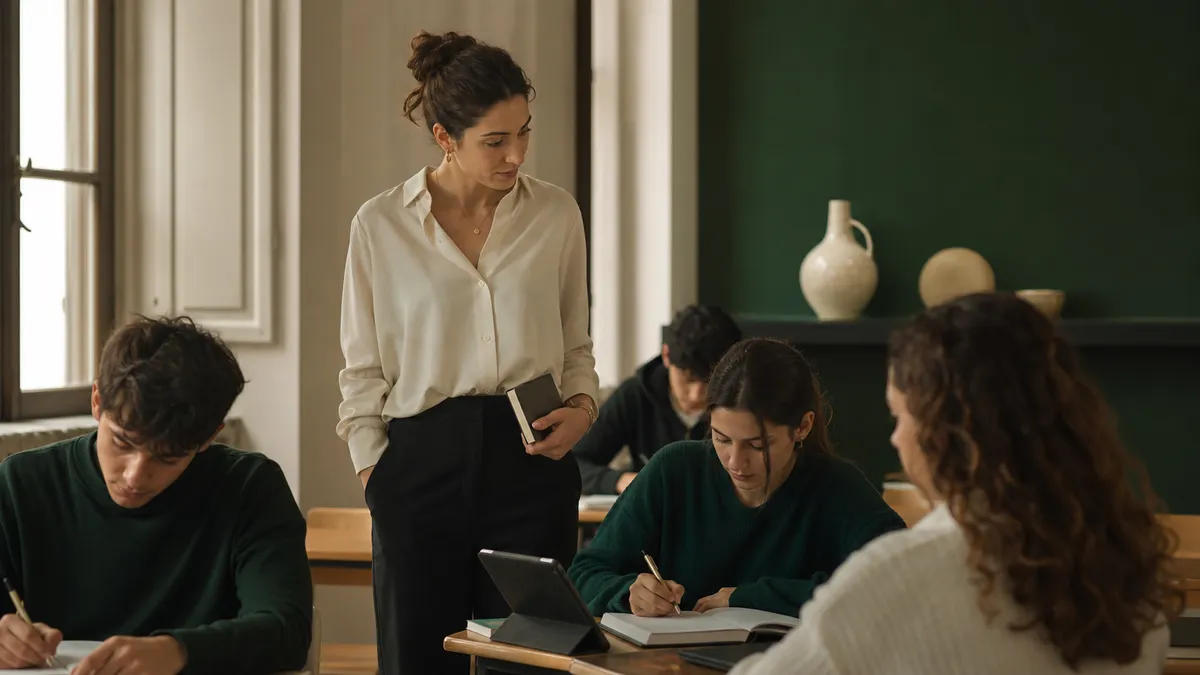
In 2026, inupper secondary schools, assessment is no longer (only) an end-of-unit check, but a continuous instructional tool: it gathers evidence, guides teachers’ choices, and makes students more aware of their own steps. The digital push of recent years has made routines that were previously too burdensome feasible: rapid data collection, real-time feedback, micro-interventions for remediation, and evenoral simulationthat is frequent and structured. Tools such asStudierAIfit into this scenario with a clear goal: makingformative assessmentsustainable in day-to-day work, without turning the teacher into a “data analyst” or reducing learning to a sequence of tests.
This article takes an operational approach: what really changes in 2026, how to designdynamic quizzes, how to structure short oral simulations with rubrics, and how to set up feedback cycles that increase engagement and autonomy. The aim is to offer classroom routines that can be replicated, with attention to pedagogical evidence and real constraints (time, heterogeneity, transparency).
Formative assessment in upper secondary schools in 2026: what really changes
Formative assessment is not a “kinder version” of grading: it is a set of practices that generate useful information toregulate teaching and learningwhile the process is underway. In 2026, the difference from summative assessment is even clearer: summative certifies (at the end of a module, term, year), formative guides (during). The first answers “how far have you met the standard?”, the second “what is the next sensible step, and how do I get there?”.
In the 2026 digital context, the “real” change is not the use of tools, but the possibility of making three actions systematic—actions that educational research identifies as high-impact:clarifying objectives,collecting frequent evidenceandproviding actionable feedback. When these three levers work, they increase the likelihood of success especially for students with vulnerabilities, because they reduce the surprise effect and make criteria and intermediate steps visible.
For upper secondary teachers, this translates into a shift from “episodic tests” to “continuous micro-evidence.” It doesn’t mean assessing all the time, butobserving better and deciding earlier: spotting misconceptions, calibrating pace, differentiating tasks, offering targeted remediation. Digital helps when it reduces organizational load and returns readable information, not when it adds platforms or compliance tasks.
A practical criterion to understand whether a practice is truly formative: after collecting evidence,does something change(in the lesson, in the assignment, in the study method, in the student’s strategies)? If the answer is no, it’s likely just measurement.
Dynamic quizzes: from factual checking to diagnosing competencies
Multiple-choice quizzes have an ambivalent reputation: efficient, but sometimes superficial. In 2026, the difference is made by design:dynamic quizzescan become diagnostic tools, able to detect levels of mastery and misconceptions in real time. “Dynamic” doesn’t just mean adaptive in the number of questions, but evidence-oriented: each item is tied to an objective, a typical error, and a consequent instructional action.
To design quizzes that go beyond factual checking, it helps to work on three levels:
- Observable objective: what the student must be able to do (not just what they must remember).
- Smart distractors: alternatives that correspond to typical errors or incomplete reasoning (misconceptions).
- Next action: what happens after the response (brief explanation, link to a targeted exercise, follow-up question).
An example in mathematics (functions): instead of asking only for the definition of domain, you can propose an item in which the student must identify the domain of a function with a square root and a denominator. Distractors can represent frequent errors (forgetting the denominator condition, confusing ≥ with >). The answer becomes a window into reasoning, not a simple “right/wrong.”
In adaptive quizzes, the sequence of questions can change based on responses: if gaps emerge in prerequisites, the path goes back; if mastery is high, it proposes transfer items (application in new contexts). This approach is consistent with competency-based teaching: it’s not enough to “know,” you need touse knowledge and strategiesflexibly.
To make quizzes truly formative, two measures are decisive:
- Use them often but “light”: 5–8 minutes at the beginning or end of the lesson, with 4–6 targeted items, reduces anxiety and increases data quality.
- Separate practice and grades: if every quiz becomes summative assessment, students optimize for the score, not for learning. Better to use results to decide remediation, work groups, personalized exercises.
In humanities subjects, dynamic quizzes can check deep understanding: in history, items on causes/connections (not just dates); in Italian, questions on inferences and stylistic choices with short excerpts; in English, cloze tests targeted at typical errors, followed by a request to rephrase. The key is that each answer generates an immediate instructional decision: targeted review, an additional example, or moving on.
Oral simulations and rubrics: assessing processes, argumentation, and metacognition
Oral assessment remains central in upper secondary school, but it is often managed discontinuously: a few long oral exams, high pressure, generic feedback. In 2026, an effective practice is to introduceWednesday: targeted group exercise on two typical errors that emerged; those who already have mastery work on transfer items.short and frequent ones (2–4 minutes), with explicit criteria. They do not replace the traditional oral exam when certification is needed, but they build competencies: organizing a discourse, arguing, using subject-specific vocabulary, handling questions, reflecting on one’s own process.
A well-designed oral simulation has a simple, repeatable structure:
- Clear prompt: a question or task that requires explanation, connection, or a justified choice (not a list).
- Short, recurring time: better 3 minutes every week than 15 minutes once a month.
- Follow-up questions: 1–2 questions to check understanding and flexibility (e.g., “what would change if…?”).
- Metacognitive closure: 20–30 seconds in which the student says what they would do better and with what strategy.
start for freeorsign up for free
- Disciplinary accuracy: correct concepts, relevant examples, appropriate use of definitions and procedures.
- Argumentative structure: clear thesis, logical steps, connections, handling objections/questions.
- Communication: vocabulary, register, clarity, effectiveness of examples, time management.
- Metacognition: ability to recognize a weak point and indicate an improvement strategy.
Example in science: prompt “Explain why an increase in CO₂ can affect ocean pH and what biological consequences it may have.” Follow-up: “What is a possible counter-argument or limitation of this explanation?” Here you assess not only knowledge, but also the ability to connect, argue, and recognize uncertainties. In philosophy: “Compare two conceptions of freedom and apply them to a contemporary case.” In business economics: “Justify an investment choice with two indicators and discuss one risk.”
Immediate and personalized feedback: practical strategies to increase engagement and autonomy

who we are.with large classes and heterogeneous levels. A practical framework is the feed-up / feedback / feed-forward cycle:
- In summary: in 2026 formative assessment in upper secondary schools becomes truly incisive when it relies on light but consistent routines. Dynamic quizzes offer rapid diagnosis; structured oral simulation trains argumentation and awareness; immediate feedback, if oriented to the next step, supports motivation and self-regulation. Technology makes sense when it reduces friction and makes evidence visible, not when it replaces teacher professionalism.
- Feedback: how am I doing? Specific indications of what worked and what didn’t, linked to the criterion (not the person).
- Feed-forward: what do I do now? A concrete next step, with timing and micro-goals.
To increase engagement and autonomy, feedback must bebrief, frequent, and action-oriented. Three practical strategies, easily integrated into classroom routines:
1) Weekly micro-goals: after a quiz or an oral simulation, each student chooses a small, verifiable goal (e.g., “I use at least two causal connectors,” “I check the sign in inequalities,” “I cite one source from the text”). The following week, you look for evidence of that micro-goal. This creates an improvement cycle and reduces dispersion.
2) Coded feedback: for recurring tasks, define 6–8 codes (e.g., A1 = argumentation: thesis missing; L2 = imprecise subject-specific vocabulary; P1 = incomplete procedure). The teacher notes the codes, the student consults the legend and produces a targeted revision. It’s a way to be fast without being vague.
3) Mandatory brief revision: after every significant formative activity, ask for a micro-revision (3 lines or 2 targeted exercises). The rule is: no feedback “lives” unless it generates an action. In this way formative assessment becomes part of learning, not an aside.
One last point, often overlooked: the best feedback is not the longest, but the one the student can use immediately. If a class receives overly complex indications, cognitive load rises and the action gets lost. Better one step forward, well chosen, than five generic pieces of advice.
How StudierAI can support teachers: workflows, use cases, and practical considerations

The point is not to “add technology,” but to build a sustainable workflow that integratesdynamic quizzes,oral simulationand feedback into a weekly routine. In this,StudierAIcan support the teacher in three ways: rapid preparation of activities, orderly collection of evidence, and delivery of customizable feedback while keeping instructional control in the teacher’s hands.
An example of a weekly workflow (replicable across many subjects):
- Monday: diagnostic mini-quiz (5 minutes) on prerequisites or concepts from the previous lesson; quick reading of results to decide whether to do a lightning remediation or proceed.
- Wednesday: targeted group exercise on two typical errors that emerged; those who already have mastery work on transfer items.
- Friday: short oral simulations (2–3 students per lesson, rotating) with a rubric; personal micro-goal for the following week.
Use examples by subject:
• Italian: dynamic quizzes on inferential comprehension of a passage; oral simulation on “thesis + two pieces of evidence from the text”; feed-forward feedback that asks to improve just one criterion (e.g., cohesion with connectors).
• Mathematics: adaptive quizzes to identify the procedural error (signs, steps, conditions); oral simulation “explain the why behind the method” on a solved exercise; feedback with a micro-goal (“always make the existence conditions explicit”).
• Languages: dynamic quizzes on frequent errors (verb tenses, collocations); short oral simulations with a situational prompt; rubric centered on communicative effectiveness and targeted accuracy (not total correction).
To start without overturning the plan, a good threshold is: one fixed formative routine per week + one revision moment. If you want to experiment gradually, you canstart for freeorsign up for freeand test a first set of activities on just one core unit, monitoring the impact on typical errors and participation.
Crucial considerations (privacy, transparency, equity) when using digital tools and AI in formative assessment:
- Clarity of purpose: communicate to students that the activity is meant to improve, not to “catch mistakes” for a grade.
- Transparency of criteria: shared rubrics and objectives; examples of expected responses; possibility of revision.
- Teacher control: interpretation of data and instructional decisions remain the teacher’s responsibility; avoid “punitive” automatisms.
- Data minimization: collect only what is needed for the formative objective and for limited periods, with clear procedures.
If you’re interested in understanding the project’s philosophy and instructional approach, you can also consultwho we are.
In summary: in 2026 formative assessment in upper secondary schools becomes truly incisive when it relies on light but consistent routines. Dynamic quizzes offer rapid diagnosis; structured oral simulation trains argumentation and awareness; immediate feedback, if oriented to the next step, supports motivation and self-regulation. Technology makes sense when it reduces friction and makes evidence visible, not when it replaces teacher professionalism.