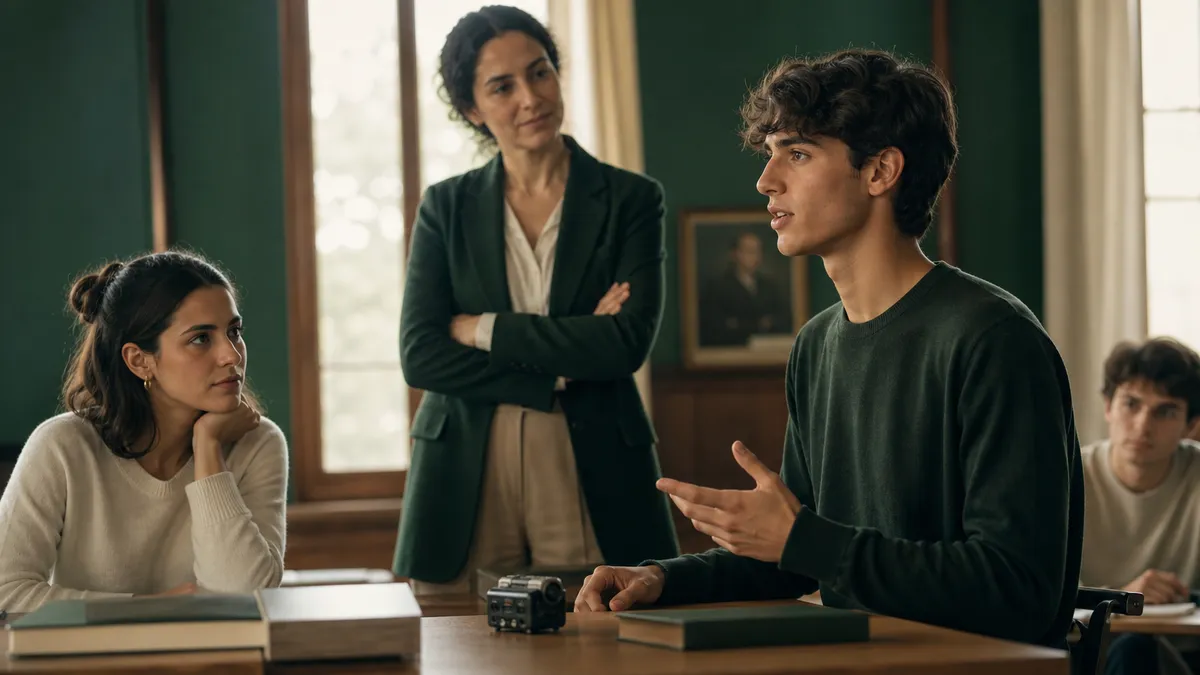
In preparing for oral exams, the difference between “knowing” and “being able to prove it” is often decisive. For the 2026 final exam, teachers and students are rediscovering a simple but very powerful practice:self-recording. Recording yourself while presenting a topic (or while answering interview-style questions) makes observable what, during an oral exam, tends to slip by: clarity, structure, time management, argumentative quality, communicative effectiveness. In this article we propose an operational method, a listening rubric, and a repeatable flow of oral simulation and feedback, with a focus on howStudierAIcan support personalized and sustainable preparation. If you want to try it right away with your class or in a small group, you canstart for freeand set up a gradual training path.
Why self-recording is becoming central in the 2026 oral exams
In recent years, oral exams—from ongoing oral questioning to the final interview—have required increasingly integrated skills: subject knowledge, connections, argumentation, anxiety management, and the ability to interact with unexpected questions. In this context, self-recording becomes an accessible “lab”: it allows you to turn an ephemeral performance into an object of analysis, on which to build targeted improvements.
From a teaching perspective, recording yourself supports three key levers. First:metacognition, because the student learns to recognize how they study and how they communicate, not only what they know. Second:feedbackthat is more precise, because you work on evidence (pauses, repetitions, unclear passages) rather than impressions. Third:deliberate practice(deliberate practice): short, frequent exercises with specific goals and verification of improvement. It is a logic particularly suited to oral exam preparation, because communicative skill is refined through repeated cycles, not through a single long presentation.
For the 2026 final exam, moreover, the complexity perceived by students often increases for two reasons: the need to keep an orderly discourse under pressure and the expectation to connect concepts and contexts in a sensible way. Recording yourself makes it possible to measure two aspects that emerge strongly in class:structure(introduction, development, conclusion) andtime(how long they ramble, where they speed up, where they get stuck). These are two trainable dimensions, but only if they are made visible.
What to evaluate when listening back: tone, clarity, concision, and argumentative stamina
To make self-recording truly formative, you need a rubric. Without criteria, the student risks stopping at global (“I did badly”) or aesthetic (“I hate my voice”) judgments. A listening rubric, instead, directs attention to observable and modifiable behaviors. Below is a proposal usable both by the teacher and by the student, with indicators that lend themselves to measurable goals.
- Subject-specific vocabulary: correct terms, use of definitions, precision (0–2 errors / 3–5 / >5).
- Coherence and structure: presence of a guiding idea, explicit logical steps, a conclusion that closes the loop (yes/no + notes).
- Examples and evidence: at least 1 relevant example every 60–90 seconds; quotations/data when required (count).
- Concision: ability to answer in 20–40 seconds to a direct question before going deeper (yes/no).
- Pace and pauses: understandable speed, functional pauses after key concepts, management of silence (notes on 2 moments).
- Fillers and repetitions: “I mean,” “like,” “basically,” “so” (count in 2 minutes).
- Argumentative stamina: clear thesis, at least 2 supporting arguments, handling an objection or follow-up question (yes/no).
- Answers to questions: restating the request, an initial short answer, then detail; conscious admission of “I don’t know” with a reasoned attempt (notes).
The key is to translate each indicator into a measurable and realistic goal. Examples:reduce fillers by 30% in two weeks;include at least two relevant examples in a 3-minute answer;always close with a summary sentence that echoes the question. When goals are clear, even teacher feedback becomes lighter and more incisive: there is no need to correct “everything,” but to choose 1–2 priorities per cycle.
Operational protocol in class and at home: from oral simulation to feedback

For teachers, the challenge is making training sustainable: tight time, large classes, grading load. A short, repeatable, paced protocol reduces improvisation and increases fairness. Below is a flow that works both in person and at home, and that adapts to different subjects.
1)Prompt or questions (2–3 minutes): prepare one “direct” question and one follow-up. Example: “Explain concept X and connect it to Y” + “What is a limitation or an exception?” With the 2026 final exam in mind, it is useful to alternate reconstruction questions (explain) and problematization questions (argue).
2)Short recording (3–5 minutes): limited duration to encourage frequency and comparison between attempts. The rule: better 4 tries of 4 minutes in a month than one 20-minute try once in a while. The recording can be audio only (simpler) or audio+video if you also want to work on posture and eye contact.
3)Guided listening back (5–7 minutes): the student listens back with the rubric and notes 2 strengths + 1 improvement priority. It is important that listening back is not “passive”: you listen looking for evidence (where did I define? where did I give an example? how much did I digress?).
4)Self-assessment (2 minutes): simple score (e.g., 1–4) on 3 indicators chosen by the teacher for that cycle: clarity, concision, examples. Self-assessment does not replace judgment, but trains calibration: the student learns to estimate the quality of their own output.
5)Teacher feedback (3–4 minutes per student, in rotation): for sustainability, not everyone receives teacher feedback in every cycle. You can work in rotation (e.g., 6 students per week) or with structured peer feedback using the same rubric. Effective feedback is specific and action-oriented: “At minute 2:10 you introduced an example, but you didn’t connect it to the thesis; try to close the example with a bridging sentence.”
6)New attempt (3–5 minutes): repetition after a short interval, focused on 1 goal. This step consolidates learning: improvement is “tested” immediately, not postponed to the next oral exam.
Recommended frequency: one micro oral simulation every 7–10 days per class (in small groups) and one independent recording at home every 10–14 days for students who need to consolidate. In view of the 2026 final exam, the last trimester can become more intensive: weekly cycles of oral simulation with stable rubrics, so that progress becomes comparable.
How StudierAI supports self-recording and oral simulation for personalized preparation
Integrating self-recording effectively requires three things: good questions, clear criteria, and continuity. This is where tools likeStudierAIcan become a teaching support, especially when the goal is to personalize oral exam preparation without multiplying the teacher’s workload. The idea is not to “delegate” evaluation, but tostructure practiceand make the transition from one attempt to the next easier.
In practice, use can be articulated into four teaching functions, consistent with oral simulation and with the needs of the 2026 final exam.
1)Organize a bank of questions and prompts: to avoid oral simulation always being “improvised,” the teacher can prepare sets of questions by thematic cores and difficulty levels (basic, intermediate, advanced). Students train on comparable prompts, and comparison between recordings becomes more reliable.
2)Targeted listening back with goals: instead of listening back to everything in a generic way, the student can focus on one indicator at a time (e.g., concision, examples, handling questions). This “in focus” logic is particularly useful for those who get lost in details or for those who have good knowledge but low presentation effectiveness.
3)Track progress across attempts: to motivate and make learning visible, it is useful to note a few stable indicators (e.g., fillers/2 minutes, presence of a conclusion, number of relevant examples). Even a simple progression sheet, shared between teacher and student, reduces anxiety and increases the sense of control (“I know what to improve and how to measure it”).
4)Personalize exercises around gaps: if a recording shows, for example, weak argumentative stamina, the next exercise should not be “repeat the topic,” but “support a thesis with two reasons and a counter-argument.” If instead the problem is clarity, the exercise can be “explain the same concept in 30 seconds, then in 90, then in 180.” Personalization reduces dispersion and makes each attempt an intentional step toward the goal.
For teachers, a practical advantage is being able to agree on a “work pact” with students: 1 short recording per week, 1 completed rubric, 1 goal. In this way the interview (or oral questioning) is no longer only assessment, but becomes the outcome of a training routine. For those who want to explore this approach, you cansign up for freeand test an oral simulation cycle with a small pilot group (for example a sample class or a group of students who need to strengthen their presentation). If you want to understand the pedagogical framework and the project, you can also consult theabout uspage to get context on approach and aims.
One last point, often overlooked: self-recording is also an equity intervention. Some students are familiar with oral presentation because they practice it in extracurricular contexts; others are not. Offering a common protocol and explicit criteria reduces the “hidden” component of performance and makes more transparent what it means to “do well” in an oral exam.
