
To stay consistent, use AI as a “light coach”: every day a 2-minute check-in (what you did, what’s left, difficulties encountered) and a plan adjustment. Also include measurable goals, for example: “30 flashcards + 1 quiz” instead of “study chapter 3.” This makes your study method more stable, because it gives you immediate feedback and reduces the anxiety of things piling up.AI study techniquesFinally, protect your time: AI is fast, but you need blocks of focus. Plan 25–50 minute sessions and use AI only at two moments: at the beginning (to define what to do) and at the end (to check and prepare the review).study methodStudierAI: how it can help you study better (practical workflow)studying with artificial intelligencewithout falling into shortcuts or confusion.
StudierAI

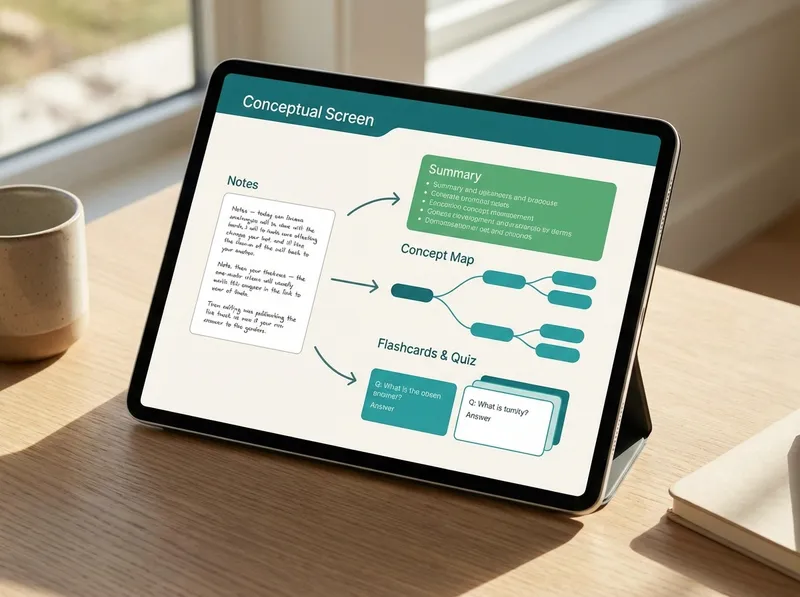
Step 1: gather the materials (slides, notes, chapters) and define the goal: “understand,” “review,” “practice.” If you don’t have an account yet, you canstart for freeand immediately set up a first structured session.organizationStep 2: generate a “layered” summary: first an overview (to orient yourself), then a paragraph-by-paragraph summary, and finally a list of concepts with definitions. This keeps you from memorizing without understanding and gives you a mental map of the topic.memoryStep 3: turn the material into exercises: flashcards + quizzes + open-ended questions. Here AI is extremely powerful because it forces you to actively retrieve information (the real engine of memory).
Step 4: clarify doubts in a targeted way. Instead of asking “explain everything,” paste the passage you don’t understand and ask for: definition, example, counterexample, and a mini-exercise to check whether you understood.tutorStep 5: track progress. Keep track of what you get wrong and repeat those points at shorter intervals. If you need to see which features are included, take a look atplans and pricingand choose the option best suited to your study load.
Mistakes to avoid and best practices: using AI in an ethical, reliable, and “anti-copy” way
Using AI well means increasing competence, not masking gaps. The first mistake is dependence: if you always ask for the answer, you train retrieval from memory very little. The second is reliability: AI can mix up terms or invent references. The third is ethics: submitting generated texts without reworking them is plagiarism and is often recognizable.
“Anti-copy” best practices (and pro-learning): use AI to have it ask you questions, not to write in your place; always ask for the explanation of the reasoning; compare with the textbook and notes; and rewrite in your own words. If you have to produce an assignment, use AI to improve structure and clarity, but keep examples, references, and arguments original.ultra-shortVerification: always ask “what do you infer that from?” and check critical points against the official material.standardPrivacy: avoid uploading sensitive data (personal documents, private information) and use only what you need for studying.with examplesActive learning: after an explanation, have it generate 3 questions and answer without looking at your notes.
If you want to start with an orderly and measurable approach, set up a small 7-day experiment: one topic, flashcards + quiz, and a daily check-in. You cansign up for freeand immediately turn your materials into study activities: it’s the fastest way to see whether these AI study techniques work for you.
3) Effective flashcards. Flashcards work when the questions are precise and the answers short. Have it generate cards of the following types: definition, true/false with explanation, fill-in-the-blank, and “why?”. Then applyspaced repetition: review more often what you get wrong, less what you know.
4) Quizzes and self-assessment. Ask for quizzes with increasing difficulty (basic → intermediate → advanced) and above all questions that requireapplication(exercises, practical cases, problems). After each answer, ask for feedback: what’s missing, where you confused concepts, how to improve.
- Useful prompt: “Turn these notes into 12 flashcards with short questions and answers of at most 2 lines, including 3 ‘why’ cards.”
- Useful prompt: “Generate a 10-question quiz: 4 multiple-choice, 4 open-ended, 2 practical cases. Also provide a grading rubric and an explanation of common mistakes.”
Study method with artificial intelligence: planning, routine, and time management
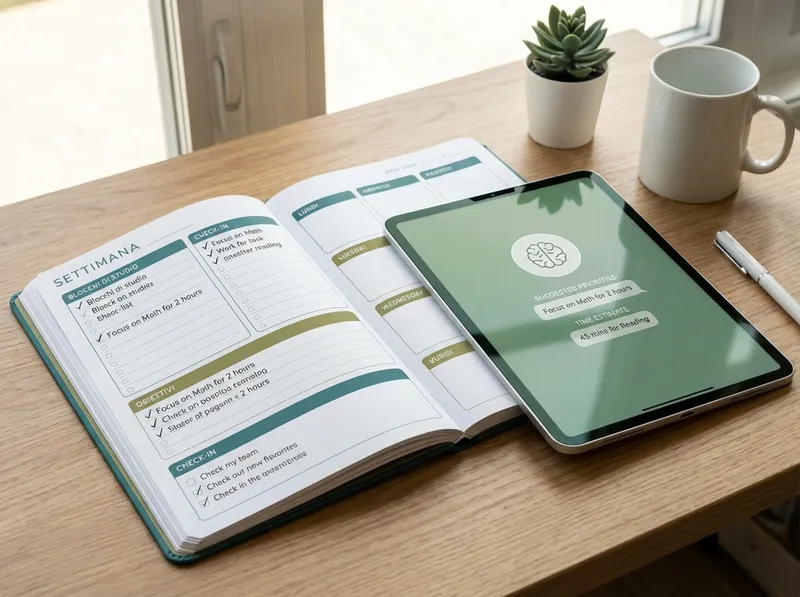
A good method doesn’t depend on willpower, but on a system. AI can help you build a realistic plan starting from three data points: exam date, amount of material, available time. From there you can have it estimate the time needed and propose a distribution that alternatesstudying,reviewandsimulations.
To stay consistent, use AI as a “light coach”: every day a 2-minute check-in (what you did, what’s left, difficulties encountered) and a plan adjustment. Also include measurable goals, for example: “30 flashcards + 1 quiz” instead of “study chapter 3.” This makes your study method more stable, because it gives you immediate feedback and reduces the anxiety of things piling up.
Finally, protect your time: AI is fast, but you need blocks of focus. Plan 25–50 minute sessions and use AI only at two moments: at the beginning (to define what to do) and at the end (to check and prepare the review).
StudierAI: how it can help you study better (practical workflow)

If you want an orderly flow (instead of a thousand chats and scattered files),StudierAIcan become your study “hub.” A practical, step-by-step workflow could be this.
Step 1: gather the materials (slides, notes, chapters) and define the goal: “understand,” “review,” “practice.” If you don’t have an account yet, you canstart for freeand immediately set up a first structured session.
Step 2: generate a “layered” summary: first an overview (to orient yourself), then a paragraph-by-paragraph summary, and finally a list of concepts with definitions. This keeps you from memorizing without understanding and gives you a mental map of the topic.
Step 3: turn the material into exercises: flashcards + quizzes + open-ended questions. Here AI is extremely powerful because it forces you to actively retrieve information (the real engine of memory).
Step 4: clarify doubts in a targeted way. Instead of asking “explain everything,” paste the passage you don’t understand and ask for: definition, example, counterexample, and a mini-exercise to check whether you understood.
Step 5: track progress. Keep track of what you get wrong and repeat those points at shorter intervals. If you need to see which features are included, take a look atplans and pricingand choose the option best suited to your study load.
Mistakes to avoid and best practices: using AI in an ethical, reliable, and “anti-copy” way

Using AI well means increasing competence, not masking gaps. The first mistake is dependence: if you always ask for the answer, you train retrieval from memory very little. The second is reliability: AI can mix up terms or invent references. The third is ethics: submitting generated texts without reworking them is plagiarism and is often recognizable.
“Anti-copy” best practices (and pro-learning): use AI to have it ask you questions, not to write in your place; always ask for the explanation of the reasoning; compare with the textbook and notes; and rewrite in your own words. If you have to produce an assignment, use AI to improve structure and clarity, but keep examples, references, and arguments original.
- Verification: always ask “what do you infer that from?” and check critical points against the official material.
- Privacy: avoid uploading sensitive data (personal documents, private information) and use only what you need for studying.
- Active learning: after an explanation, have it generate 3 questions and answer without looking at your notes.
If you want to start with an orderly and measurable approach, set up a small 7-day experiment: one topic, flashcards + quiz, and a daily check-in. You cansign up for freeand immediately turn your materials into study activities: it’s the fastest way to see whether these AI study techniques work for you.