

Artificial intelligence is changing the way we learn: not only because it makes it faster to create study materials, but because it can help you study better, more consistently, and with less distraction. In this article you’ll find the best AI study techniques and a practical study method for studying with artificial intelligence without falling into the most common traps (copying, superficiality, dependence on the tool).
personalized study plans

on the most frequent mistakes; and keep track of your reviews to apply spaced repetition without having to manage everything by hand. If you want to try it, you canstart for freeand see how it adapts to your subjects.speedAn important point: personalization works only if you stay active. Use StudierAI as an accelerator for your study method: ask questions, take the quizzes, analyze mistakes, and update the plan. If you’re interested in understanding which option best suits your needs, you’ll find the details onplans and pricing.
In short: AI study techniques make it easier to create materials (summaries, maps, flashcards, quizzes), but the real leap in quality comes when you plug them into a workflow with goals, short sessions, and spaced reviews. If you want guided support to study with artificial intelligence consistently, you can alsosign up for freeand start building your path, one topic at a time.
- Always verify the key concepts in the textbook, slides, or official sources (especially definitions and formulas).
- Use AI to generate questions and exercises, not to replace studying: memory is built through active recall.
- Ask for “layered” explanations: first simple, then more technical, then with examples and counterexamples.
- Keep ownership of the process: AI helps you decide what to do, but the final decision remains yours.
AI study techniques to understand and memorize better (summaries, maps, flashcards, quizzes)

AI study techniques work best when they turn “passive” material (notes, chapters, slides) into “active” activities. Your goal isn’t to read more, but toretrieve information from memoryand connect it together. Here are four practical techniques you can apply right away.
1) “Smart” summaries (not just shorter). Instead of asking for a generic summary, ask for: definitions, logical steps, examples, common mistakes, and 5 final questions. A good prompt is: “Summarize in 10 points, then create 5 open-ended questions and 5 multiple-choice questions, including an explanation of the answer.” This way the summary already becomes a basis for self-assessment.
2) Concept maps and connections. AI is useful for identifying cause-and-effect relationships, hierarchies, and dependencies between concepts. Ask for a tree structure (main topic → subtopics → details) and then verify it yourself: if a connection doesn’t convince you, ask “why” and bring out the reasoning. The map is powerful because it supportsdeep understanding, not just memorization.
3) High-quality flashcards (with distractors and examples). Flashcards work when they’re specific and test only one concept at a time. You can ask AI to generate: question, short answer, applied example, and a “trap” (typical mistake). Even better: ask it to create mixed cards, some definitional and others case-based (“Given this scenario, which principle applies?”).
4) Quizzes and exam simulations. Here AI really shines: you can generate tests with increasing difficulty, with reasoned corrections. Always specify: included topics, level (basic/intermediate/advanced), available time, and exam format. After answering, ask for an error analysis: “Which concept am I missing? Which logical step am I skipping? What exercise do you recommend to close the gap?” This is the core of thestudy method: a continuous cycle between practice and correction.
Study method with artificial intelligence: planning, focus, and spaced repetition
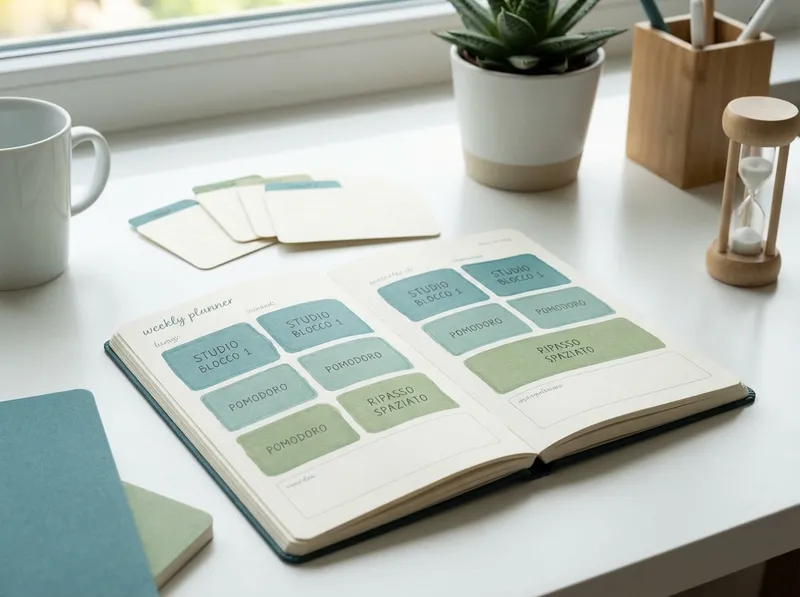
Studying with artificial intelligence becomes truly effective when you have a repeatable workflow. You don’t need a complicated system: clear goals, short sessions, and distributed reviews are enough. Here’s a 5-step method, suitable for school and university.
Step 1 — Define the goal (output, not time). Instead of “I study 2 hours,” aim for “I can explain chapter 3 and answer 15 questions without looking at my notes.” AI can help you turn the syllabus into measurable goals and identify missing prerequisites.
Step 2 — Plan in blocks (micro-sessions). Use 25–40 minute sessions with a 5-minute break. Ask AI to break a long topic into “one-session units” and suggest the order: first foundational concepts, then exercises, then cases. This reduces procrastination because each block is manageable.
Step 3 — Focus: one thing at a time. During the session, use AI as an “on-demand tutor”: clarify a specific doubt, get an example, then go straight back to the task. If you get lost in details, ask: “What’s the 20% of concepts that gives me 80% of the understanding?” and build from there.
Step 4 — Spaced repetition. Memory improves when you review at intervals: for example after 1 day, 3 days, 7 days, 14 days. AI can create a review calendar and generate targeted quizzes based on your mistakes. The practical rule: each review should be short and based on questions, not rereading.
Step 5 — Weekly review and method improvement. Once a week, look at what worked: which topics blocked you, which quizzes you got wrong, how much time you actually spent. Ask AI to suggest adjustments: more exercises? more maps? less material per session? This makes your study method increasingly efficient.
StudierAI: how it can help you personalize your study path

If you want to apply the techniques you’ve seen in an organized way (without wasting time “making up” prompts, quizzes, and a calendar each time), a dedicated solution can make a difference.StudierAIis designed to support students in building a personalized path: from organizing goals to practice and progress tracking.
Specifically, it can help you: createpersonalized study plansbased on exam date and available time; generate exercises and targeted quizzes on the topics you’re working on; give youfeedbackon the most frequent mistakes; and keep track of your reviews to apply spaced repetition without having to manage everything by hand. If you want to try it, you canstart for freeand see how it adapts to your subjects.
An important point: personalization works only if you stay active. Use StudierAI as an accelerator for your study method: ask questions, take the quizzes, analyze mistakes, and update the plan. If you’re interested in understanding which option best suits your needs, you’ll find the details onplans and pricing.
In short: AI study techniques make it easier to create materials (summaries, maps, flashcards, quizzes), but the real leap in quality comes when you plug them into a workflow with goals, short sessions, and spaced reviews. If you want guided support to study with artificial intelligence consistently, you can alsosign up for freeand start building your path, one topic at a time.
