In 2026, preparation fororal examsis changing substantially: not because the oral exam has become “easier,” but because we can train more precisely the skills that determine success. Argumentation, time management, clarity of exposition, the ability to answer unexpected questions, and anxiety control are skills developed primarily through practice. Today, thanks toimmersive simulationsandaugmented reality, we can bring training closer to real exam conditions without turning the classroom into a permanent tech lab. In this article you’ll find an operational model designed for teachers: objectives, scenarios, assessment criteria, and best practices. We’ll also see howStudierAIcan support the design and monitoring of simulations in a didactically sound and responsible way.
Why immersive simulations are changing preparation for oral exams in 2026
The oral exam assesses knowledge, but above allcommunicative performance in context: the student must recall content, organize it, adapt it to the interlocutor, and manage pressure. Educational and psychological research reminds us that learning is more robust when we work with authentic or “near-authentic” contexts: training that reproduces the constraints and demands of the real task increases transferability (transfer) and reduces the gap between “I know the theory” and “I can explain it well.”
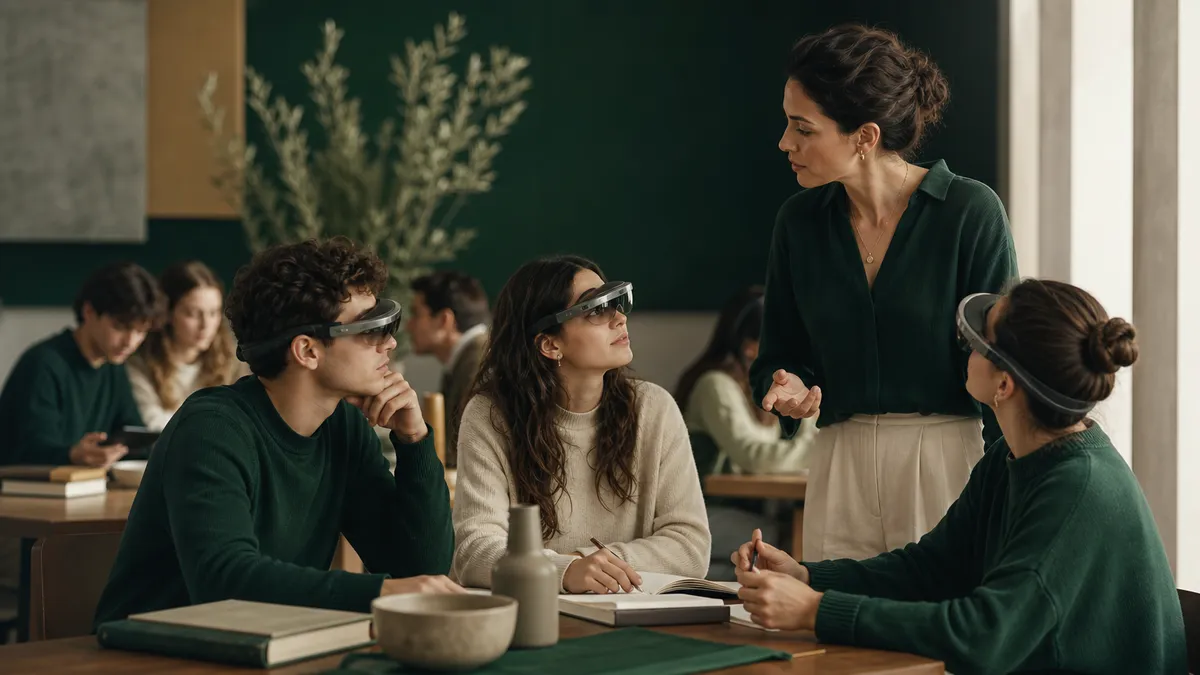
This is whereimmersive simulationscome into play. With immersive environments (even lightweight ones, not necessarily with complex headsets) and with augmented reality, it’s possible to recreate typical elements of the oral exam: interpersonal distance, turn-taking, response times, follow-up questions, shifts in register, managing a support (images, concept maps, objects). The experience becomes more “true to life” than a simple peer-to-peer questioning, because it includes contextual cues and a level of sustained attention closer to the exam moment.
From a pedagogical standpoint, three mechanisms are particularly relevant:
- Deliberate practice: repetition with clear goals, immediate feedback, and progressive difficulty (more complex questions, tighter timing, greater unpredictability).
- Situated learning: the student builds skills in a context that resembles real use, improving access to knowledge when needed (retrieval and application).
- Desensitization to performance anxiety: gradual exposure to an exam-like situation, with control and support, reduces emotional arousal and improves self-efficacy.
In the classroom, the most useful effect is not “putting on a show” with technology, but creating abridge between studying and performance. When students practice explaining a concept in an immersive context, they tend to pay more attention to the structure of their discourse, monitor the interlocutor’s understanding more, and handle interruptions better. This makes preparation fairer: it doesn’t reward only those who are already “quick on their feet,” but allows everyone to improve through repeated cycles and clear criteria.
How to integrate immersive simulations into teaching: design, timing, and criteria
Effective integration requires a guiding principle:the simulation is a teaching device, not an event. It works when it is tied to specific objectives and coherent assessment. Below is a “lightweight” operational model (replicable in any subject) for inserting simulations into the learning path without upending the syllabus.
1) Define observable objectives (not just content). Beyond the disciplinary core, make explicit which behaviors you want to train: for example “argues with relevant examples,” “handles a clarification question,” “uses subject-specific vocabulary,” “connects two concepts.” This step makes the simulation a tool forformative assessment, not a simple test.
2) Design short, repeatable scenarios. An effective scenario lasts 6–10 minutes per student (or 10–12 if it includes follow-up), with a set of questions and one “variable” that changes (a source, a case, a counterexample). Immersion can be adjusted: from augmented reality with contextual objects/images to a more enveloping environment. What matters is that the scenario reproduces the constraints of the oral exam: time, turns, demands for precision, the need to rephrase.
3) Prepare an essential rubric (3–5 criteria). A short rubric is more usable and fairer. Cross-cutting example:
- Disciplinary accuracy (correctness, completeness, examples).
- Discourse structure (introduction, development, synthesis, connections).
- Interaction management (listening to the question, asking for clarification, relevant answer).
- Language and register (subject-specific vocabulary, clarity, pace).
- Self-regulation (time management, recovery after a mistake, emotional control).
4) Plan sustainable timing. A realistic schedule includes distributed micro-simulations: for example, one session every 2–3 weeks, integrated into the end-of-unit check. In a large class you can use rotations: while 3–4 students simulate, the others work on observation tasks using the rubric (guided peer assessment) or prepare follow-up questions. In this way, the simulation also becomes education in listening and assessment.
5) Take inclusion and accessibility seriously. Not everyone experiences immersion well: some students may have sensory sensitivities, attentional difficulties, or simple discomfort. Always provide anon-immersive alternative modewith the same objectives (traditional role-play, structured interview, presentation with a timer and questions). Equity does not mean uniformity: it means offering different paths to reach the same competencies.
6) Always close with a debriefing. The most “didactic” phase is often after: 3 minutes of self-assessment (what worked, what to improve), 2 minutes of teacher feedback, 1 concrete action for the next simulation. This keeps the focus on growth rather than judgment.
StudierAI + augmented reality: guided simulations, personalized feedback, and progress tracking

To make simulations sustainable, you need tools that reduce organizational load and increase the quality of feedback. From this perspective,StudierAIcan be used as instructional support to design scenarios, guide practice, and collect evidence useful to teachers and students. The value is not in “replacing” the teacher, but in making practice cycles more frequent and targeted, especially when class time is limited.
Here are three integration modes consistent with innovative yet pragmatic teaching.
A) Creating exam scenarios and question banks. Starting from a teaching unit, the teacher can define: conceptual cores, typical errors, follow-up questions, and success criteria. The scenario can include variants (basic/intermediate/advanced level) to differentiate without changing the objective. Augmented reality can add contextual “stimuli”: a historical document, a geometric figure, an experiment, a literary source, an artifact, a map. The student doesn’t recite from memory:interprets and argueson variable materials, as often happens in more authentic oral exams.
B) Personalized, immediate feedback. Effective feedback is specific, timely, and action-oriented. In simulations, StudierAI can help provide guidance on aspects such as: clarity, argumentative coherence, coverage of key concepts, use of examples, handling questions. For the teacher, this means being able to focus intervention on the truly important nodes (misconceptions, gaps, communication strategies), instead of spending time repeating the same generic advice. For the student, it means having an “improvement task” between one attempt and the next: for example, rephrasing the introduction, preparing two examples, practicing a 30-second final summary.
C) Progress tracking and metacognition. Oral-exam preparation improves when the student can see the trajectory: what is improving, what remains fragile, which strategies work. Tracking (even simple) makes it possible to move from “I’m hopeless” to “I’m improving on X, I need to work on Y.” From an instructional standpoint, data should be read asevidence for decision-making: which micro-lessons to do, which remedial activities to assign, how to form peer-tutoring groups.
An example routine (15–20 minutes a week) that many teachers find sustainable:
- 5 minutes: briefing (today’s objective + rubric criterion).
- 8–10 minutes: simulation (in rotation or in pairs with a guided scenario).
- 5 minutes: debriefing + micro-goal for home (a rephrasing, a summary, two examples).
If you want to explore the tool with a gradual approach, you cansign up for freeand test a first simulation on a topic you’re already covering. To learn more about the pedagogical vision and the team, you’ll find more information on theabout uspage.
Assessment, ethics, and quality: reliability, bias, privacy, and accessibility

Adopting immersive tools and AI-based supports requires a clear framework:instructional quality and responsibilitymust be designed, not taken for granted. For teachers, it is useful to distinguish between formative use (training, feedback, self-assessment) and summative use (grading). Immersive simulations are particularly powerful for formative purposes; for summative assessment, instead, even more rigorous criteria and careful control of variables are needed.
Reliability and assessment consistency. If the simulation produces scores or indicators, ask yourself: what do they really measure? Are they consistent with the rubric? Does the same performance receive similar evaluations at different times? A good practice is to keep the teacher’s rubric as the reference and use any automatic indicators asdescriptive support(examples of improvement, critical areas), not as a “final judgment.” Also, standardize scenarios: same timing, same number of questions, same level of complexity, with controlled variants.
Bias and equity. Oral performance can be influenced by accent, shyness, communication style, neurodivergence, and linguistic background. Technology can amplify these effects if countermeasures are not adopted. Best practices:
- Transparency: explain to students objectives, criteria, and data use; share examples of responses at different rubric levels.
- Triangulation: combine teacher observation, self-assessment, and (if used) automatic indicators, avoiding decisions based on a single source.
- Differentiation: allow different preparation methods (maps, keywords, outlines) as long as aligned with the same objectives; assess competence, not adherence to a single style.
Privacy and data protection. Simulations can generate recordings, transcripts, performance metadata. In schools it is essential to minimize data, define retention periods, clarify who accesses what and for what purpose. In practice: collect only what is needed for feedback, anonymize when possible, avoid unnecessary sharing, and inform families and students in understandable language. Trust is a teaching condition: without it, the simulation becomes “surveillance” and loses effectiveness.
Accessibility and alternatives. Even when the school has devices, not everyone can or wants to use them. Always provide a parallel pathway: same scenario, but mediated by paper materials or guided role-play. Also, take care of practical aspects: break times, the option to sit, volume control, reducing stimuli. The goal is to train for the oral exam, not to test sensory tolerance.
In summary, immersive simulations work when they meet three conditions:instructional design,quality feedbackandresponsible adoption. If you want to experiment without impacting the syllabus, start with just one scenario and a short rubric: once the routine is established, you can expand gradually. To try a first guided pathway you canstart for freeand build a simulation consistent with your classroom objectives.