
School is undergoing a tangible transformation: it’s not just about “using technology,” but about rethinking time, spaces, and teaching methods to make learning more effective, inclusive, and measurable. In this scenario,digital teachingbecomes a set of practices and tools that help teachers plan, manage, and assess, reducing dropout and organizational workload. The aim of this article is to offer an operational overview of the most useful innovative digital tools today, with practical criteria for choosing what really works in the classroom.
Why digital teaching is changing school (and what teachers really need)

The push toward educational technology comes from very concrete needs: heterogeneous classes, different educational needs, the need for continuity between in-person learning and at-home activities, and the demand for traceability (assignments, progress, assessments). What makes the difference are the tools that simplify daily work and improve students’ experience, not those that add complexity.
To choose effective and sustainable teaching tools, it’s worth applying a few quick criteria. A good tool should beeasy to get started with(clear onboarding),accessible(works across multiple devices and for different needs),compatiblewith your organization (institutional accounts, sharing, exports), andtransparentabout data and privacy. Finally, ask yourselves: does this tool reduce downtime? Does it help differentiate? Does it make objectives and instructions clearer? If the answer is yes, it’s a sensible investment.
- Start from an instructional need (e.g., quick feedback), not a tech trend.
- Prefer tools with ready-made, reusable models (lessons, rubrics, quizzes).
- Assess the impact on workload: fewer steps, more automation where possible.
Platforms and learning environments: LMSs, virtual classrooms, and content management

An LMS (Learning Management System) or a well-set-up virtual classroom is the “backbone” of digital teaching: it reduces fragmentation across chats, emails, and scattered files. In practice, it’s used to centralize materials, assignments, assessments, and communications, keeping a clear record of what has been done and what’s still missing.
To make it truly inclusive, take care of three aspects:structure(weekly modules with objectives and timing),clarity of instructions(a visible rubric or criteria), andaccessibility of materials(readable PDFs, appropriate fonts, text alternatives for images, videos with subtitles when possible). Content management also makes a difference: better a few well-named, versioned files than many repeated, disorganized resources.
A practical approach is to create a recurring “lesson package”: objective, brief explanation, guided activity, assignment, assessment criteria, Q&A channel. This repetition reduces students’ organizational anxiety and speeds up teacher preparation, especially when working in teams or across parallel classes.
Real-time assessment and feedback: quizzes, digital rubrics, and data analysis

Digital assessment isn’t just “posting grades online”: it’s a way to get quick signals about understanding, misconceptions, and progress. Quizzes (even short ones, at the beginning or end of a lesson) are perfect forformative assessment: they help decide whether to move on, revisit a concept, or propose differentiated exercises. For summative assessment, on the other hand, you need transparent criteria and tools that reduce ambiguity and disputes.
Digital rubrics make it possible to assess complex competencies (oral presentations, written work, projects) with clear indicators. The advantage is twofold: on the one hand, students understand what “counts”; on the other, the teacher maintains consistency across classes and over time. When the rubric is integrated with the assignment, feedback becomes faster and less scattered.
Finally, data: even simple tools offer statistics on the most-missed questions, submission times, participation. You don’t need to become a “data analyst,” but to use two essential readings:where the class gets stuck(to redesign the explanation) andwho needs targeted support(for remediation or enrichment). This way, educational technology becomes a tool for personalization, not an end in itself.
Content creation and interactive lessons: video, dynamic presentations, and collaborative activities
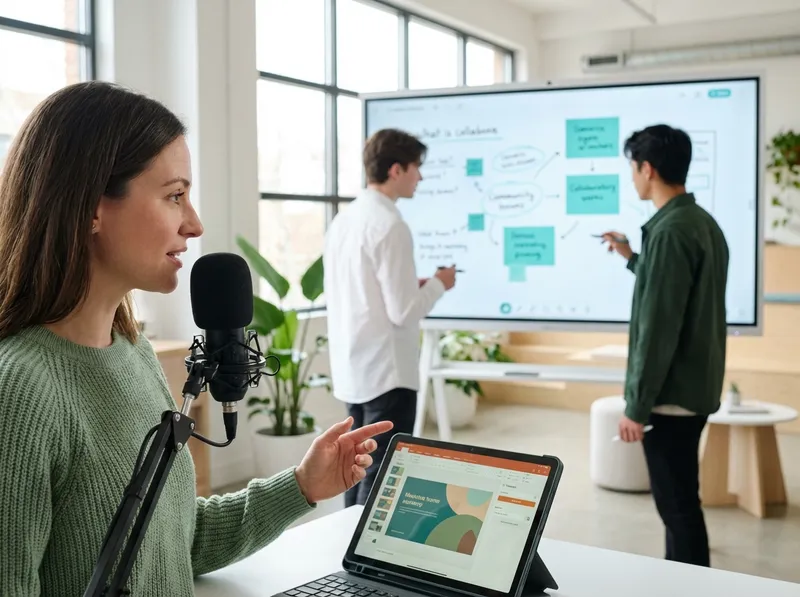
Creating digital content doesn’t mean producing “perfect lessons,” but useful, reusable resources. A short video (3–7 minutes) can be used to introduce a concept in advance (flipped), for review before a test, or to support those who are absent. Dynamic presentations, with integrated questions and moments of choice, increase attention and make the logical steps visible.
For engagement, simple collaborative activities work well: digital boards for brainstorming, shared documents for group writing, online whiteboards for concept maps. The key element isrole design(who does what) and the instructions (what to submit, by when, with what criteria). Without these two levers, even the best tool risks becoming confusing.
A practical tip: build a personal library of instructional “building blocks” (slide templates, standard instructions, grids, recurring activities). This way, digital teaching becomes more sustainable: you update one piece at a time, instead of starting from scratch every time.
AI and automation for teachers: how StudierAI can support planning, differentiation, and inclusion

AI can become a real ally when it’s used for what consumes the most time: preparing outlines, differentiating materials, generating examples, building rubrics, and turning objectives into activities. The point isn’t to delegate teaching, but to speed up repetitive phases while keeping the teacher’s pedagogical direction. In this logic,StudierAIcan support planning with customizable outputs, aligned with objectives, prerequisites, and the class level, helping turn an idea into a ready-to-adapt instructional sequence.
Here are some high-impact use cases for teachers, especially when time is short and classes are complex:
- Planning: a draft learning unit with objectives, activities, timing, assessments, and materials.
- Differentiation: simplified or enriched versions of the same task, with more guided or more open-ended instructions.
- Inclusion: language adaptations, concrete examples, maps and outlines to support understanding and autonomy.
- Assessment: rubrics and criteria, quiz questions, model feedback to customize for the student.
To get started in a practical way, you canstart for freeand test a simple flow: lesson objectives → activity → quick check → rubric. AI makes the first draft faster; the final quality depends on your instructional choices, the classroom context, and the professional review that only a teacher can ensure.
If you’re considering ongoing adoption, check what’s included in theplans and pricingand choose the solution most consistent with your use (individual teacher, department, school). With the right tools, educational technology doesn’t add work: it frees up time for what really matters—relationship, guidance, care, and high-quality instructional design.