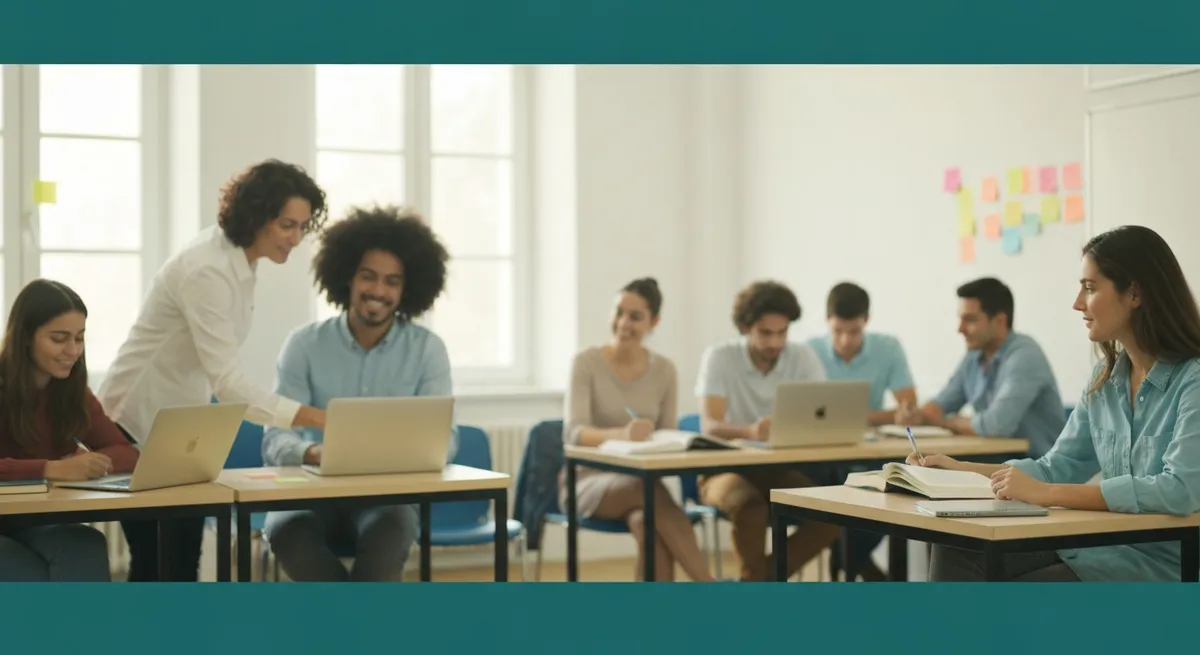
In 2026, classes and universities are increasingly “mixed”: students fresh out of school, workers returning to training, upskilling learners, and people studying for personal goals share the same pathway. For 2026 teachers, this means rethinking design, communication, and assessment with a new focus onintergenerational learning: not as a “social issue,” but as a measurable teaching competence. In this article we look at practical techniques and howStudierAIcan supportpersonalized teachingthanks to AI technologies, while maintaining inclusion and rigor.
Why in 2026 intergenerational learning is a key teaching competence

The coexistence of different generations is not just a matter of age: it changes expectations, motivations, study pace, and communication channels. In the same class, someone seeking speed and micro-content can coexist with someone who prefers depth and more linear structures; someone used to collaborating in chats and someone who relies on paper notes; someone who studies “for the exam” and someone who studies “to apply it at work tomorrow.” The point is not to choose a single model, but to intentionally design experiences that turn diversity into a resource.
In 2026, moreover, familiarity withAI technologiesis unevenly distributed: some students use them daily, others avoid them or fear them. This creates asymmetries of access (and performance) that the teacher must manage with clear rules, authentic tasks, and support tools. Intergenerational learning, if well orchestrated, reduces these gaps: those with greater digital confidence can support the group, while those with more professional experience can provide context and practical meaning to the content.
Mapping needs and study styles across generations: signals, data, and instructional diagnosis
Talking about generations risks slipping into stereotypes (“young people are…,” “adults do…”). To avoid this, you need aninstructional diagnosisbased on evidence: observations, micro-data, and structured moments of metacognition. The goal is to identify barriers and preferences without labeling people, distinguishing between “habit” and “need” (e.g., do I prefer short videos because they’re more effective, or because I don’t yet have active reading strategies?).
A practical mapping can start from three levels of evidence:
- Formative: low-stakes diagnostic quizzes, exit tickets, short-answer questions to check prerequisites and misconceptions.
- Behavioral: participation patterns (who speaks up, who observes), submission times, collaboration modes, use or non-use of digital resources.
- Metacognitive: brief guided self-reflections (“how did you study?”, “what would you do differently?”), strategy checklists, weekly goals.
With these signals, the teacher can build need profiles useful for design: for example, who needs scaffolding on study method, who needs flexibility in timing to balance work and training, who requires advanced challenges to avoid disengaging. This is where personalized teaching becomes concrete: not “one pathway for each person” (impossible), butequivalent optionsto reach the same outcomes (materials in multiple formats, different practice modes, graduated levels of support).
Practical techniques for intergenerational learning: design, activities, and assessment
To make intergenerational learning work, you need instructional direction: clear roles, shared objectives, and transparent assessment. Below is a set of practices adaptable to school, ITS, and university.
1) Structured peer learning. Form pairs or triads with complementary strengths (professional experience, digital skills, subject-matter competence). Give a short, verifiable task and a protocol: explanation time, question time, shared synthesis. The teacher observes and collects evidence, intervening only to unblock conceptual knots.
2) Reverse mentoring. In dedicated modules, students who are more experienced with digital tools (or effective study practices) support their classmates; in other modules, those with work experience lead on real cases, ethics, constraints, and decisions. The value lies in the alternation: everyone has a chance to be both “expert” and “apprentice.”
3) Authentic tasks and multi-level assignments. Propose a real-world problem (project, case, critical analysis) with three layers: mandatory baseline, optional extension, advanced challenge. This way, those with less time or higher cognitive load don’t get lost, and those who are ready can go deeper without “breaking away” from the group.
4) Transparent rubrics and negotiated criteria. Make quality criteria explicit (accuracy, argumentation, application, collaboration). If possible, spend 10 minutes having students propose examples of “good work”: this aligns expectations among those coming from different educational backgrounds and reduces conflicts over assessment methods.
5) Frequent micro-feedback. In intergenerational contexts, feedback “at the end of the module” arrives too late: better short cycles (48–72 hours) with actionable guidance. An effective format is: “what works” + “one point to improve” + “next step.” This supports motivation and self-regulation, especially for those returning to study after years.
How StudierAI supports teachers: personalized teaching and effective communication with AI technologies
When working with heterogeneous groups, the bottleneck is often time: differentiating materials, proposing calibrated exercises, and providing feedback requires energy the teacher doesn’t always have. This is where AI technologies come into play, if used with instructional criteria and responsibility.StudierAIcan become an ally to make intergenerational learning smoother and more measurable, without losing control over learning objectives.
In practice, support can be structured in four directions:
- Differentiation of materials: concise versions and extended versions, glossaries, applied examples, guiding questions for active reading, while maintaining coherence with the expected outcomes.
- Adaptive study paths: sequences of exercises and reviews based on recurring errors and missing prerequisites, useful both for those who accelerate and for those who need to catch up.
- Faster, more consistent feedback: draft comments anchored to rubrics (clarity, correctness, argumentation), with “next step” suggestions to encourage revision and autonomy.
- Inclusive communication: clear rephrasings of assignments, study reminders, examples of “good” questions to ask, to reduce misunderstandings between different communication habits.
For 2026 teachers, the added value is not “automating” the educational relationship, but freeing up time for the most human part: observing, asking questions, facilitating mixed groups, managing dynamics and motivations. If you want to explore the approach in a practical way, you canstart for freeor learn more about the project on theabout uspage.
In summary: intergenerational learning works when it is designed (not left to chance), fueled by evidence, and supported by micro-feedback. With personalized teaching and the responsible use of AI technologies, it is possible to improve results, classroom climate, and sense of belonging. If you want to experiment with your students, you can alsosign up for freeand start with a small pilot module: a single well-assessed intergenerational activity is worth more than a total change that isn’t sustainable.
