Integrating AR takes time: ideation, materials, differentiation, assessment. This is where AI can make the difference, especially when organized into a workflow for teachers.StudierAIcan support you in four key areas.StudierAI1) Rapid ideation and curriculum alignment. Starting from subject, grade level, and prerequisites, you can get already-structured AR activity proposals: objectives, phases, instructions, guiding questions, and possible typical mistakes. This reduces the risk of designing experiences that are “nice but useless” and keeps the focus on skills and content.immersive technologies2) Personalization and differentiation. For the same augmented activity, you can generate variants by level (basic/intermediate/advanced), simplified language versions, supports for SEN/SLD, and extension tasks for faster students. In this way,immersive technologiesbecome an accelerator ofpersonalized learningwithout multiplying the preparation workload.who we are3) Content and pathway creation. Even when 3D models come from libraries or departments, they still need to be “didacticized”: observation sequences, points of attention, comparison activities, checklists, rubrics. StudierAI can help transform an asset into a pathway: what to observe, in what order, with which questions, and which evidence to collect. This is where AR truly becomes
, because it integrates method and content.
4) Monitoring and feedback. For augmented activities, the problem is often not “doing,” but understanding what has been learned. An AI support can suggest check questions, observation grids, and mini transfer tasks, helping you collect evidence in a lightweight way and provide timely feedback. This also makes it easier to document the experience for the department, class council, or university accreditations.engagementIf you want to start with a simple prototype, choose just one teaching unit, define an assessable output, and try a micro AR activity. Then iterate: improve the instructions, timing, and rubric. To try the workflow with AI support, you cansign up for freeand build your first augmented pathway with objectives, inclusion, and assessment already in mind.experiential learning: you move from explanation → exercise to scenario → decision → feedback, with a positive impact on memory and skills transfer.
In 2026 AR is more relevant also for practical reasons: more accessible devices, more mature standards, and content that is easier to produce. For high schools and universities, this means being able to integrate short activities (5–15 minutes) into a traditional lesson, or design extended labs (45–120 minutes) where AR becomes the “bridge” between theory and practice. In both contexts, the goal is not to amaze, but to make visible concepts that would otherwise remain abstract, reducing errors and increasing the quality of classroom discussion.
Concrete use cases of AR in the classroom and in the lab (high school and university)
To make AR sustainable, it’s best to start from repeatable scenarios: activities with clear timing, minimal materials, and observable results. Below are some subject-specific examples, adaptable to the first/second two-year period and to university courses.
STEM (physics, chemistry, biology, engineering). Activity: “Take apart and reassemble” a system (complex molecule, circuit, organ) with annotations. Timing: 10 minutes briefing + 20 minutes guided exploration + 15 minutes check. Materials: smartphone/tablet, instruction sheet, validated 3D model. Expected results: reduction of misconceptions (e.g., bonds, flows, cause-effect relationships) and improved quality of students’ oral explanations.
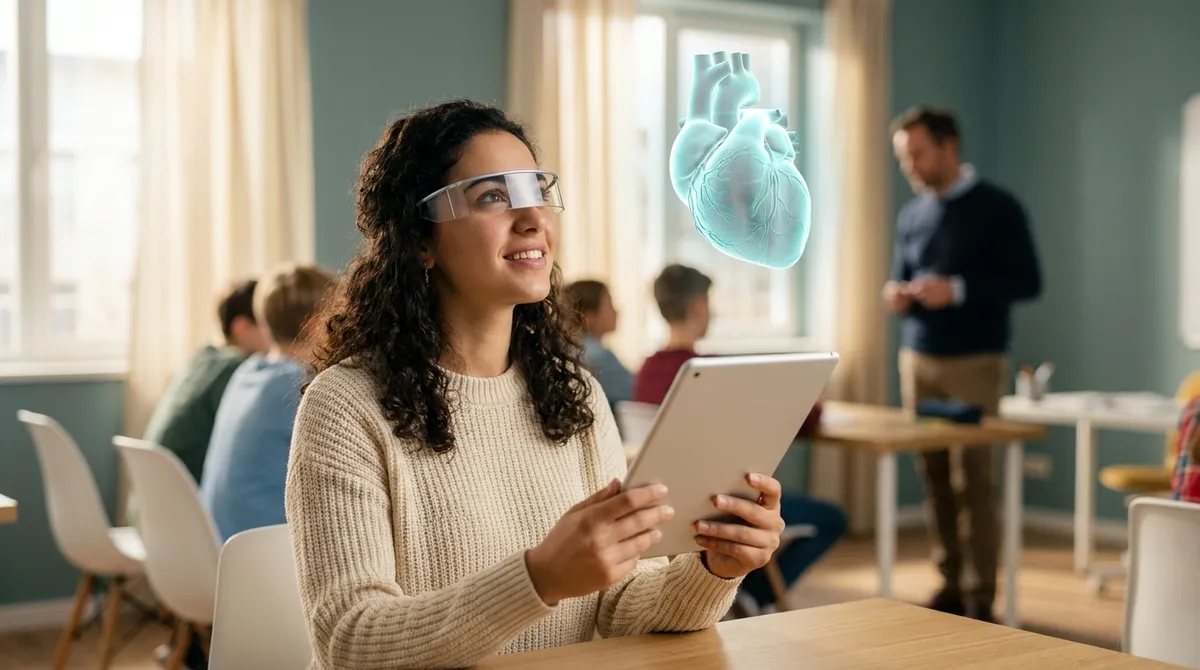
Medicine and health professions. Activity: simulation of a clinical pathway with overlay on a mannequin or physical model (device placement, anatomical recognition, procedures). Timing: 15 minutes pre-test + 30 minutes scenario + 20 minutes debriefing. Materials: mannequin or model, checklist, AR content with difficulty levels. Expected results: improved procedural sequencing, greater confidence with technical language, and ability to identify errors safely (without risk to the patient).
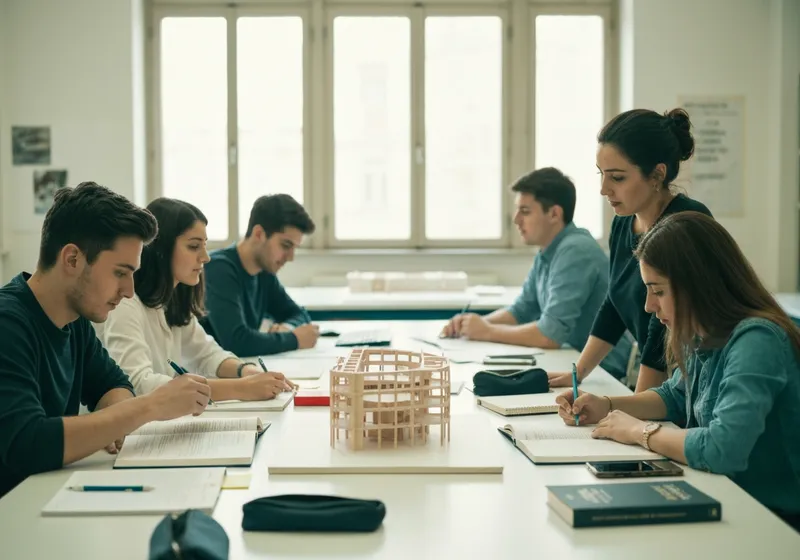
Architecture, design, and construction. Activity: AR project review, overlaying a structure onto a real space to check clearances, routes, light, and accessibility. Timing: 10 minutes setup + 25 minutes walkthrough + 25 minutes rubric-based review. Materials: reference floor plans, 3D model, criteria grid (functionality, safety, accessibility). Expected results: better-justified design decisions and fewer scale and spatial-compatibility errors.
Languages, cultural heritage, and art history. Activity: an “augmented visit” in the classroom or museum with reconstructed objects/monuments and micro language tasks (description, argumentation, role-play). Timing: 5 minutes warm-up + 20 minutes stations + 15 minutes wrap-up. Materials: vocabulary sheets, audio tracks, 3D objects or environmental markers. Expected results: increased oral production, richer subject-specific vocabulary, and better historical-cultural contextualization.
In all cases, the key is to define an “observable task”: the output can be a recorded explanation, a short report, a completed checklist, an annotated photo, or a mini-presentation. This way AR remains a tool serving the objectives, not an end in itself.
- Micro-activities (5–12 min): one concept, one model, one guiding question.
- Standard activities (25–50 min): exploration + task + whole-class wrap-up.
- Lab (60–120 min): complex scenario, group roles, structured debriefing.
How to design an AR lesson: objectives, inclusion, assessment
A good AR lesson starts with measurable objectives and clear instructional direction. In practice: first you decide what the student must be able to do, then you choose which augmented experience makes it more likely.
1) Objectives and criteria. Phrase objectives in performance terms: “Identify and explain,” “Apply a procedure,” “Compare two alternatives.” Associate 2–4 observable indicators (accuracy, use of vocabulary, quality of reasoning, collaboration). AR works well when the objective requires visualization, manipulation, or decision-making in context.
2) Classroom management. Plan roles (device operator, instruction reader, observer/checker, presenter) and block timing. Include a “screen break” for discussion: without this step, AR risks becoming unguided exploration. In the lab, set safety rules and movement spaces, especially if headsets are used.
3) Inclusion and accessibility. Offer equivalent alternatives: 2D diagrams, audio descriptions, tactile materials where possible, and multi-modal instructions (short text + icons + examples). For students with SLD or language needs, reduce cognitive load: one variable at a time, essential glossary, progressive guiding questions. The goal is an augmented experience that supportspersonalized learning, not one that complicates it.
4) Privacy and data. If the activity involves photos, video, or scanning the environment, define what is allowed and what is not, how materials are stored, and for how long. Prefer institutional accounts and settings that minimize data collection. At university, also clarify the management of intellectual property for models and projects.
5) Assessment with rubrics. Use a simple 4-level rubric (beginner, basic, intermediate, advanced) on 3–4 criteria. Example: (a) conceptual accuracy, (b) procedure application, (c) argumentation, (d) collaboration. Assess the output (explanation, report, checklist) rather than “time in AR.” Add a short exit ticket to check transfer: “explain without AR,” “solve a similar case,” “justify a choice.”
How StudierAI can help integrate AR into teaching
Integrating AR takes time: ideation, materials, differentiation, assessment. This is where AI can make the difference, especially when organized into a workflow for teachers.StudierAIcan support you in four key areas.
1) Rapid ideation and curriculum alignment. Starting from subject, grade level, and prerequisites, you can get already-structured AR activity proposals: objectives, phases, instructions, guiding questions, and possible typical mistakes. This reduces the risk of designing experiences that are “nice but useless” and keeps the focus on skills and content.
2) Personalization and differentiation. For the same augmented activity, you can generate variants by level (basic/intermediate/advanced), simplified language versions, supports for SEN/SLD, and extension tasks for faster students. In this way,immersive technologiesbecome an accelerator ofpersonalized learningwithout multiplying the preparation workload.
3) Content and pathway creation. Even when 3D models come from libraries or departments, they still need to be “didacticized”: observation sequences, points of attention, comparison activities, checklists, rubrics. StudierAI can help transform an asset into a pathway: what to observe, in what order, with which questions, and which evidence to collect. This is where AR truly becomesinnovative teaching, because it integrates method and content.
4) Monitoring and feedback. For augmented activities, the problem is often not “doing,” but understanding what has been learned. An AI support can suggest check questions, observation grids, and mini transfer tasks, helping you collect evidence in a lightweight way and provide timely feedback. This also makes it easier to document the experience for the department, class council, or university accreditations.
If you want to start with a simple prototype, choose just one teaching unit, define an assessable output, and try a micro AR activity. Then iterate: improve the instructions, timing, and rubric. To try the workflow with AI support, you cansign up for freeand build your first augmented pathway with objectives, inclusion, and assessment already in mind.