
In 2026, schools are increasingly moving toward models ofcollaborative teachingcapable of supporting motivation, inclusion, and transversal skills. In this scenario,peer tutoringis not an “extra,” but a structural lever: students who explain to other students, with clear roles and routines, become a powerful instructional resource.artificial intelligencecan amplify this approach if used with criteria of quality, transparency, and teacher responsibility. In this article we look at howStudierAIcan support more sustainable, traceable peer tutoring oriented towardpersonalized learning, without losing sight of ethics and inclusion. If you want to explore the tool, you canstart for freeand also take a look atwho we areto understand the educational vision behind it.
: not just “it went well,” but observable traces (answers to key questions, typical errors corrected, explanation of the process). 5)
: rubrics, self-assessment, and co-assessment, with a brief whole-class debrief.metacognitionA concrete routine (30–40 minutes) can be: 5 minutes of check-in (goal and criteria), 20 minutes of paired tutoring with a guide, 5 minutes of individual check (micro-quiz or exercise), 5–10 minutes of reflection: what worked, which question unblocked me, which mistake I won’t make again. AI comes in as support: it helps prepare the guide, make the rubric readable, suggest comprehension-check questions. The teacher remains the director: observes, intervenes on misconceptions, safeguards the climate, and ensures that tutoring is a learning experience, not a judgment.inclusionEthics, privacy, and inclusion: conditions for safe and effective use
Using AI in peer tutoring requires a clear framework. On the ethical level, responsibility remains with the teacher: define purposes, check quality, prevent improper uses (copying, total delegation, exposure of sensitive data). On the privacy level, it is prudent to adopt the principle of
- : avoid entering personal information, diagnoses, identifying details; prefer anonymous examples and subject-matter content. It is also useful to make transparency explicit: when was AI used? To do what? With what limits? This clarity educates toward responsible use and reduces evaluative ambiguities.
- Inclusion also means preventing dependence on AI and ensuring equity of participation. Some practical strategies: (1) alternate “AI-off” moments in which you work only with traditional tools; (2) use AI to generate questions, not final answers; (3) assign roles that value different skills (facilitator, checker, synthesizer); (4) provide accessible adaptations (time, sources, simplified instructions) without lowering cognitive goals. Finally, watch out for bias: if an AI suggestion seems to penalize a group or propose stereotypes, it should be discussed and corrected. This, in itself, is digital civic education: the class learns that AI is a powerful but fallible tool, to be questioned critically.
- When peer tutoring and artificial intelligence meet with solid design, the result is a more autonomous and more cohesive class: students learn to explain, listen, and improve, while the teacher regains time to observe and intervene where it’s truly needed. If you’re looking for a practical way to start this transformation, explore
- and experiment with a single unit: a clear rubric, a well-built tutoring guide, and a brief final reflection can already make a difference.
Where artificial intelligence (really) enhances peer tutoring
AI does not replace the educational relationship: it enhances peer tutoring when it reduces organizational friction and improves the quality of interactions. In practice, it can help in four high-impact areas. First:tutor–tutee pairings. It’s not enough to “put a strong student with one who’s struggling”: you need compatibility of pace, goals, communication style, and specific content. Second:scaffoldingfor explanation: guiding questions, graduated examples, analogies, comprehension checks. Third:formative feedbackthat is timely, criteria-based, and focused on next steps. Fourth:personalizationof exercises and explanations, in a way consistent with the lesson’s level, prerequisites, and objectives.
For this enhancement to be real, however, quality criteria are needed. Some limits and risks are well known: inaccurate answers, misleading oversimplifications, an overly “solution-oriented” tone that reduces cognitive effort, homogenization of explanations, and possible bias. For teachers, a useful operational rule is to distinguish between AI as acoach(which suggests questions, criteria, strategies) and AI as an “oracle” (which gives answers). In peer tutoring, AI should mostly stay in the first role. In addition, maintaining traceability is crucial: what was asked, which criteria were used, which evidence shows that the student truly understood.
StudierAI in the classroom: features and use scenarios to facilitate peer tutoring
In a peer tutoring context,StudierAIcan be used as methodological support: not to “do things in place of students,” but to make the task clearer, feedback more robust, and management more sustainable. A first scenario is thecreation of guided promptsfor tutors: guides that help them explain step by step, ask diagnostic questions, and check understanding. For example, a tutor can start from a guide that requires them to: (1) ask the tutee what they already know; (2) propose a simple example; (3) have them solve a micro-exercise; (4) ask them to explain “how you got there.”
A second scenario concernsrubrics and criteria: StudierAI can help the teacher turn general objectives (“explain well,” “argue”) into observable indicators, with levels described in a way students can understand. This makes co-assessment fairer and reduces vague or judgmental feedback. A third scenario is the production ofdifferentiated explanation guides: the same competence can be proposed with different examples and language, while keeping the criteria consistent. Here AI supportspersonalized learningwithout fragmenting the class into isolated tracks: everyone works on the same core, with calibrated scaffolding.
Finally, useful for management: light monitoring of progress (for example session checklists, collected evidence, recurring difficulties) and tools for collaboration (roles, timing, expected outputs). The goal is to give the teacher an overall view without turning tutoring into bureaucracy. To experiment quickly, you cansign up for freeand start with a single weekly routine, then scale up gradually.
Designing a pathway: roles, routines, and assessment of AI-supported peer tutoring
To make peer tutoring with AI effective, it’s worth designing a five-step pathway, simple but rigorous. 1)Define objectives and boundaries: what should students be able to do after the session? Which content is “tutorable” and which requires direct teacher intervention? 2)Train the tutors: a micro-lesson on how to ask questions, manage silences, use examples, not give the solution right away. Better 15 minutes done well than “improvising.” 3)Establish a session protocol: timing, speaking turns, outputs (e.g., 3 exercises solved with explanation, a concept map, a mini-summary). 4)Collect evidence: not just “it went well,” but observable traces (answers to key questions, typical errors corrected, explanation of the process). 5)Assess to improve: rubrics, self-assessment, and co-assessment, with a brief whole-class debrief.
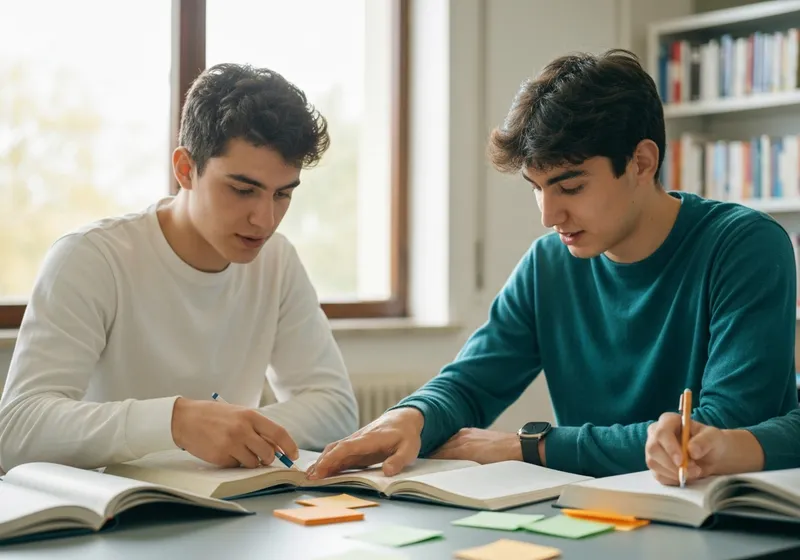
A concrete routine (30–40 minutes) can be: 5 minutes of check-in (goal and criteria), 20 minutes of paired tutoring with a guide, 5 minutes of individual check (micro-quiz or exercise), 5–10 minutes of reflection: what worked, which question unblocked me, which mistake I won’t make again. AI comes in as support: it helps prepare the guide, make the rubric readable, suggest comprehension-check questions. The teacher remains the director: observes, intervenes on misconceptions, safeguards the climate, and ensures that tutoring is a learning experience, not a judgment.
Ethics, privacy, and inclusion: conditions for safe and effective use
Using AI in peer tutoring requires a clear framework. On the ethical level, responsibility remains with the teacher: define purposes, check quality, prevent improper uses (copying, total delegation, exposure of sensitive data). On the privacy level, it is prudent to adopt the principle ofdata minimization: avoid entering personal information, diagnoses, identifying details; prefer anonymous examples and subject-matter content. It is also useful to make transparency explicit: when was AI used? To do what? With what limits? This clarity educates toward responsible use and reduces evaluative ambiguities.
Inclusion also means preventing dependence on AI and ensuring equity of participation. Some practical strategies: (1) alternate “AI-off” moments in which you work only with traditional tools; (2) use AI to generate questions, not final answers; (3) assign roles that value different skills (facilitator, checker, synthesizer); (4) provide accessible adaptations (time, sources, simplified instructions) without lowering cognitive goals. Finally, watch out for bias: if an AI suggestion seems to penalize a group or propose stereotypes, it should be discussed and corrected. This, in itself, is digital civic education: the class learns that AI is a powerful but fallible tool, to be questioned critically.
When peer tutoring and artificial intelligence meet with solid design, the result is a more autonomous and more cohesive class: students learn to explain, listen, and improve, while the teacher regains time to observe and intervene where it’s truly needed. If you’re looking for a practical way to start this transformation, exploreStudierAIand experiment with a single unit: a clear rubric, a well-built tutoring guide, and a brief final reflection can already make a difference.