

In 2026,Augmented Realityis no longer a “wow effect,” but a concrete lever forEducational innovation: it makes complex concepts visible and manipulable, connects theory and practice, and strengthensDigital teachingwith active experiences. In this scenario, tools likeStudierAIcan help teachers designImmersive learningpathways that are sustainable, assessable, and inclusive, both in the classroom and in independent study.
The goal of this article is to offer a practical guide for high school and university teachers: why AR is didactically relevant today, which scenarios really work, and how to integrate augmented activities with a skills-oriented approach to assessments and exam preparation.
Why Augmented Reality in 2026 changes learning (especially for high school and university)
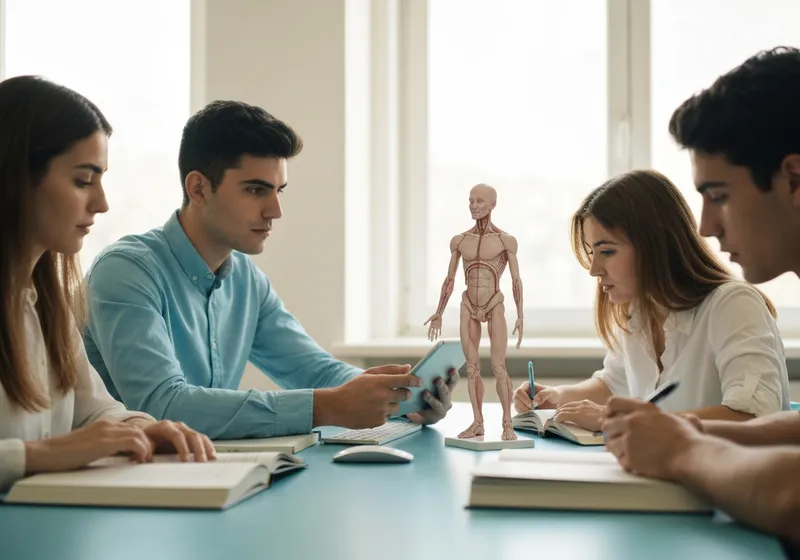
In 2026, Augmented Reality is more accessible: more powerful mobile devices, lightweight glasses in some schools/universities, cloud platforms, and ready-to-use content. The point is not the technology itself, but the instructional effect: turning the abstract into the concrete and making objects “manipulable” that would otherwise remain two-dimensional or only described in words.
Think of three typical examples of complex concepts: (1) a molecular structure that the student can rotate, enlarge, and “take apart” to recognize bonds and geometries; (2) a vector field or an electromagnetic wave visualized in space to connect formulas and phenomena; (3) a historic building layered into construction phases, observable level by level. In all cases, AR supports understanding because it reduces the cognitive load tied to mentally translating from 2D to 3D and fosters learning through exploration.
For high school and university teachers, this also means greater continuity between classroom and at-home study: the same augmented experience can be revisited for review, to prepare for a test, or to consolidate critical steps before the exam. If well designed, AR does not replace the book, the lecture, or the physical lab: it enhances them, making “contact” with the phenomenon being studied more frequent.
Immersive instructional scenarios: lessons, virtual labs, and guided study for exams
To move from experimentation to everyday teaching, it helps to think in terms of scenarios and competencies. Below you’ll find 5 discipline-specific use cases with operational guidance on activities, assessment, and exam preparation.
- STEM (physics/chemistry/biology): interactive 3D models of systems, molecules, circuits. Activity: “predict and verify” (hypothesize what happens when changing a parameter, then observe in AR). Assessment: short-answer questions on cause-and-effect relationships and representations (graphs/laws) connected to what was manipulated. Exam: guided review of typical errors (e.g., confusion between scalar/vector quantities) with contextual micro-exercises.
- Medicine and health professions: augmented anatomy, simulated clinical pathways, triage and procedures. Activity: identification of structures and correlation with symptoms (clinical reasoning). Assessment: “light” OSCE with checklists and an oral explanation of the steps. Exam: flashcards and situational quizzes anchored to 3D models, to train terminology and spatial orientation.
- Architecture and civil engineering: overlaying structural elements onto scale models or real environments, reading construction details, interference checks. Activity: “design critique” with constraints (lighting, accessibility, flows). Assessment: submission with rubrics (clarity of choices, coherence, compliance with constraints). Exam: simulations of oral questions starting from a shared augmented model.
- History and art: reconstructions of contexts (a city in a given era), stratigraphies, artworks “disassembled” by techniques and materials. Activity: source/object analysis with guiding questions (what do I see, what do I infer, what do I need to verify). Assessment: a short argumentative essay with observed evidence. Exam: concept maps anchored to augmented objects to remember chronologies and causal links.
- Languages: augmented scenarios for role-play (at the airport, in a clinic, in a company), labelable and describable objects, micro-situations with communicative constraints. Activity: authentic task (book, ask for information, negotiate). Assessment: rubrics on accuracy, fluency, communicative strategy. Exam: review by “situations” rather than by chapters, with immediate feedback on recurring errors.
In all scenarios, design works best if you start from: (1) an observable objective (competency or sub-skill), (2) the student’s action (what they must do in the augmented world), (3) assessable evidence (product, answer, explanation), (4) rapid feedback (teacher, peers, or a digital tutor). This way AR becomes a stable component of Digital teaching and not an isolated activity.
StudierAI + AR: how to integrate targeted hands-on digital experiences into your teaching
Integrating Augmented Reality and Immersive learning requires content, instructional direction, and continuity between lesson, practice, and review. This is whereStudierAIcomes in, as support for design and tutoring: the idea is to create targeted hands-on digital experiences, with short but frequent activities anchored to the course objectives.
An effective flow can be this: the teacher defines a module (e.g., “electrostatics,” “cardiovascular system,” “European Gothic”), selects or structures augmented content, and then links it to assessment moments. StudierAI can facilitate the creation of pathways withadaptivity: different students receive different reinforcement (more examples, more explanations, more exercises) based on difficulties and performance, without multiplying the teacher’s preparation workload.
Operationally, the StudierAI + AR integration can include:
- AR pathways for teaching units: short sequences (5–12 minutes) with a clear objective, guided exploration, and a final deliverable (answer, outline, oral explanation).
- Tutoring and guided study: step-by-step suggestions when the student gets stuck, with reminders of prerequisites and analogous examples.
- Contextual quizzes: questions “anchored” to the augmented object (identify, compare, predict, justify) to assess understanding and not just memory.
- Personalized materials for lessons and review: summaries, glossaries, graded exercises, and authentic tasks, aligned with the course outline.
- Instructional analytics: evidence of where students get stuck, which concepts generate errors, which augmented activities produce measurable improvements.
If you want to explore the approach and understand how it translates into practice, you can start withstart for freeorsign up for free. To learn about the educational vision and the team, you’ll find more details inabout us.
Classroom implementation: requirements, inclusion, privacy, and impact evaluation
To make Augmented Reality a stable practice, you need an essential checklist: minimum technology, classroom management, accessibility, data protection, and effectiveness measurement. Here is an operational guide to get started without complications.
Requirements (devices and connectivity). In many contexts, a set of smartphones/tablets (including BYOD with clear rules) and a stable connection is enough. Always plan a “plan B” offline or low-bandwidth option (video, preloaded 3D images, activity sheets) to avoid the lesson depending on the network. If you use headsets, plan short rotations and sanitization.
Classroom management. AR works best in station mode or in small groups: roles (observer, note-taker, “checker” who verifies criteria), timed segments, and a brief final deliverable. To avoid distraction, make explicit what to look at and what to note down: free exploration only makes sense after a guided phase.
Inclusion and accessibility. Design equivalent alternatives: audio or textual descriptions of the model, static images with guiding questions, the option to work in pairs (one manipulates, the other argues/explains). Consider students with visual, vestibular, or attention difficulties: short sessions, breaks, reduction of unnecessary stimuli, very clear objectives. Immersive learning is effective when it remains controllable and does not overload.
Privacy and data security. Define what data is collected (accounts, progress, results), for how long, and for what purposes. Minimize what isn’t needed, avoid unnecessary video recordings, inform students and families when required, and align use with the institution’s standards. If the activity uses the camera and the real environment, clarify framing rules and prohibitions (faces, documents, others’ work).
Impact evaluation (rubrics and KPIs). To truly measure Educational innovation, pair perceived engagement with learning indicators. Some useful KPIs: improvement between pre-test and post-test, reduction of typical errors, quality of explanations (argumentation), transfer to new problems, time on task, and completion rate. Use rubrics with explicit criteria (accuracy, use of disciplinary language, justification, collaboration) and collect evidence: answers to contextual quizzes, short reports, micro-presentations.
When these elements are in balance, Augmented Reality becomes an accelerator of Digital teaching: it not only makes lessons more engaging, but improves understanding, autonomy, and exam preparation. And with support like StudierAI, design can remain sustainable over time, without sacrificing disciplinary rigor and assessment.
