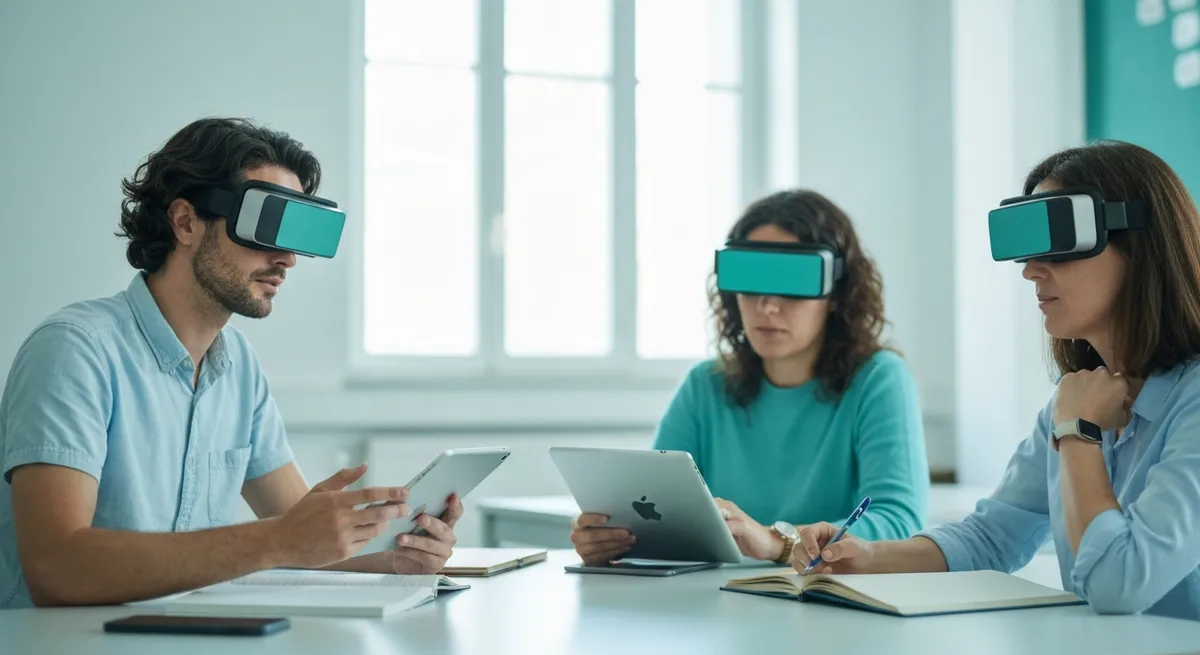
In 2026,augmented realityis no longer a “lab experiment”: it’s a concrete lever fordigital teachingto createimmersive lessonswithout disrupting schedules, curricula, and classroom management. In this scenario, tools likeStudierAIhelp teachers design AR activities that are replicable, inclusive, and assessable, with a measurable impact on attention and understanding. The goal of this article is to offer you a practical guide: what has changed in 2026, which use cases really work, and how to integrate AR with quality and control, aiming for realeducational innovation.
Why augmented reality in the classroom in 2026 is truly accessible

If until a few years ago AR seemed expensive, fragile, or “too technical,” in 2026 several factors make it a viable choice for everyday teaching. The first is cost: compatible devices (smartphones and tablets already available or regulated BYOD) run AR experiences smoothly, and lightweight headsets are more common in labs or in small shared sets. The second is connectivity: more stable school Wi‑Fi and better-performing mobile networks reduce downtime, while many experiences also work offline after downloading the content.
The content landscape has changed too. Today there are libraries of 3D models, simulations, and ready-made “scenes,” often aligned with curricula. But above all, authoring tools have matured: creating or adapting an activity no longer requires development skills. In parallel, schools have consolidated practices forprivacy management, institutional accounts, and policies for device use in class. This lowers the barrier to entry and makes AR less of a “special event” and more of a methodology: short, targeted, and integrated with explanation, practice, and assessment.
In practice, AR in 2026 is accessible because it respects three typical school constraints:time(quick setup),reliability(stable content), andeducational value(clear, verifiable objectives). If an AR activity doesn’t improve understanding or participation, it’s not worth the effort. The most effective experiences are brief immersive “windows” within a well-structured lesson.
Instructional use cases: immersive lessons across different subjects
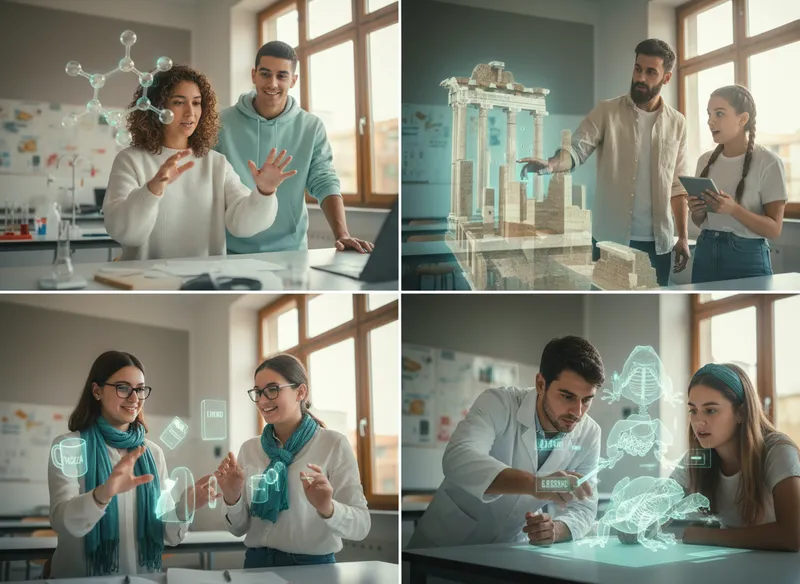
Below you’ll find concrete examples, designed to be replicable with common devices and to produce observable results in terms of engagement and understanding. The key idea is to use augmented reality to make visible what is abstract, distant, or too small/large for the classroom.
STEM (math, physics, technology) —Objective: understand spatial relationships and quantities. Activity: students explore a 3D model of a bridge or a geometric solid, measure angles/forces with overlays, change parameters, and observe the effect. Expected results: greater accuracy in moving from the model to the problem, fewer visualization errors, richer discussion because everyone “sees the same thing.”
History and art —Objective: contextualize works and periods. Activity: AR “reconstruction” of a historic building or an archaeological site over a classroom map; students follow a guided track (timeline, materials, functions of spaces) and produce a short narrative. Expected results: better memorization thanks to spatiality, stronger links between historical causes/effects, more detailed oral/written production.
Languages —Objective: expand vocabulary and automate communicative functions. Activity: an AR “vocabulary hunt” with objects labeled in space (classroom, home, city) and paired micro-dialogues: one student describes, the other finds and uses the word in a sentence. Expected results: increased speaking time, reduced anxiety thanks to structured play, improved pronunciation if integrated with audio feedback.
Science (biology, chemistry, Earth science) —Objective: observe processes and structures that aren’t accessible. Activity: an AR model of a cell or body system, with activatable layers; “station” quizzes where each group explores an organ/part and fills in a worksheet. In chemistry, 3D visualization of molecules and bonds to connect structure and properties. Expected results: deeper understanding of processes, fewer misconceptions, greater collaboration in groups.
To make these use cases sustainable, it helps to standardize a format: brief introduction, guided exploration, production (worksheet, map, explanation), quick check. AR doesn’t replace the lesson: it strengthens it where static images or text struggle.
How to design an AR lesson: objectives, timing, inclusion, and assessment

An augmented reality lesson works when it’s designed like any other teaching unit: with objectives, success criteria, and predictable classroom management. Here’s an operational guide, designed to reduce surprises and increase effectiveness.
- Define 1–2 measurable objectives: what will students be able to do at the end? (e.g., describe a structure, apply a formula, argue for a choice).
- Plan short, paced timing: 5’ briefing, 12–15’ guided exploration, 10’ production, 5’ debrief and quick check.
- Choose the working mode: stations (reduces the number of devices needed), pairs (supports language and collaboration), or whole-class with demonstration + micro-tasks.
- Prepare visual instructions and classroom rules: where to stand, how to move the device, when to speak, how to ask for help. Clarity reduces noise and distraction.
- Inclusion and accessibility: provide alternatives (printed worksheets, video, 3D model on a large screen), roles in the group (observer, narrator, technician), readable fonts, and recovery time for those who tire easily.
- Safety and well-being: set visual breaks, watch for movement, no running; ensure the activity doesn’t require unnecessary recording and complies with school policies.
- Assessment: use a simple rubric (content, language/argumentation, collaboration, accuracy). Add a 3-question “exit ticket” to check immediate understanding.
One decisive precaution: prepare a non-technological “plan B.” If a device doesn’t work or the network is unstable, the activity must be able to continue with images, worksheets, or a teacher demonstration. This redundancy maintains authority and instructional continuity.
How StudierAI can help: from content design to activity management

Integrating augmented reality takes time: selecting content, writing instructions, planning adaptations, building assessments. This is whereStudierAIcomes in, supporting you throughout the entire design and delivery cycle, keeping your teaching professionalism and the class’s real needs at the center.
In the design phase, you can use AI to turn a curriculum topic into a ready-to-use learning sequence:objectives, prerequisites, AR activities, guiding questions, and support materials. The value isn’t “putting on a show,” but getting a more focused lesson: clear instructions, realistic timing, verifiable outputs (worksheet, concept map, recorded explanation, quiz).
During activity management, StudierAI can help produce variants for different levels: a simplified track for those who need more structure, an extension for those who move faster, and a version with simplified language. This is especially useful in heterogeneous classes, where AR can amplify differences if it isn’t accompanied by scaffolding.
On the assessment side, you can quickly generate: 4-level rubrics, observation grids for group work, and sets of questions (comprehension, application, metacognitive reflection). The goal is to make the AR experiencedocumentableand therefore defensible: not “we tried a technology,” but “we achieved a learning goal with evidence.”
If you want to explore in a practical way how to organize content, instructions, and assessments for immersive lessons, you canstart for freeorsign up for freeto try a guided design workflow. To learn about the vision and the team behind the platform, you’ll find more information on theabout uspage.
In 2026, the combination of digital teaching and augmented reality is mature: what makes the difference isn’t novelty, but design. With clear objectives, sustainable timing, inclusion, and assessment, AR becomes a stable ally. And with the support of StudierAI, the most demanding part—preparing and adapting materials—can be reduced, leaving you more space for what matters: the educational relationship, guidance, feedback, and care for the class.
