
In 2026,digital educationis no longer a “Plan B”: it is the natural environment in which lessons are designed, evidence is collected, learning paths are personalized, and motivation is built. Forhigh school teachers(and for those who teach at university) the question is not whether to use digital tools or AI, but how to do so with quality, equity, and transparency. In this scenario, platforms likeStudierAIcan become an ally forinnovative teachingprovided the educational relationship remains central and clear routines are defined. If you want to explore the approach in a practical way, you can alsostart for freeand test sustainable workflows for your class.
From the post-pandemic period to 2026: why the teacher’s role really changes

Distance learning has had an irreversible effect: it has made it visible that learning can happen in more places, at more times, and through more media. In the post-pandemic period many schools “brought everything back in person,” but they could not unlearn what remote learning accelerated: platforms, digital materials, activity tracking, asynchronous communication, and new expectations from students and families.
In 2026 the teacher is not “less important” because intelligent tools exist: on the contrary, they increasingly become adirector of learning environmentshybrid (in-person + digital), inclusive (accessibility and differentiation), anddata-informed(decisions based on evidence, not impressions). This means designing coherent experiences, choosing tools with discernment, reading the signals (data, outputs, interactions), and intervening in a timely way, without turning the classroom into a dehumanizing “dashboard.”
Key competencies for teachers in advanced digital education
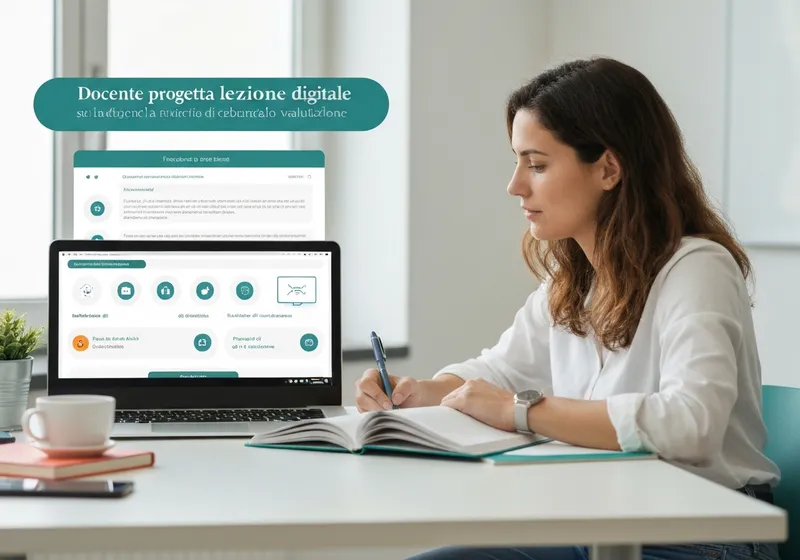
For high school and university teachers, “advanced” digital education does not coincide with knowing how to use an app. It is a set of professional competencies that intertwine with the subject taught and with classroom management. Some pillars are now indispensable:
- Digital instructional design: clear objectives, coherent activities, accessible materials, and “ambiguity-proof” instructions.
- Authentic assessment: real-world tasks, products, presentations, labs, and transparent criteria (rubrics) that reduce “copy and paste.”
- Attention management: micro-activities, short time blocks, alternating synchronous/asynchronous work, opening and closing rituals, and anti-distraction strategies.
- Inclusion and personalization: compensatory tools, UDL (Universal Design for Learning), differentiated levels, and different channels to demonstrate competence.
- AI literacy: being able to explain limits, hallucinations, responsible use, and how to verify sources and reasoning.
- Privacy and data protection: data minimization, informed consent when necessary, attention to accounts and sharing, and choosing tools compliant with institutional policies.
These competencies do not require becoming IT technicians. They require, rather, adesign-oriented professionalism: defining what matters, how it is observed, and how it is improved over time.
StudierAI as an ally: personalization, instructional management, and continuous feedback

Theintegration of AI in schoolsworks when AI reduces repetitive workload and increases the quality of interactions. In this sense,StudierAIcan support teachers in three high-impact areas: personalization, instructional organization, and feedback. The goal is not to “automate the teacher,” but to free up time for what only a teacher can do: read the context, motivate, negotiate meaning, build trust, and build a learning community.
Operationally, an AI ally can help to: generate exercise variants for different levels, propose examples and counterexamples, build assessment rubrics aligned with objectives, suggest review questions and remedial activities. In addition, it can support more timely feedback, especially in draft phases: comments on structure, clarity, completeness, and logical steps.
The essential condition is to define clear boundaries: what can be assisted by AI and what must remain the student’s own work. The educational relationship is protected in this way too: by making the learning agreement explicit. If you want to understand the project’s philosophy and underlying choices, it may be useful to take a look atwho we areand at how study support is conceived.
Integration strategies in the classroom and at university: models, activities, and routines

Integrating tools like StudierAI requires an instructional design, not an isolated “tech moment.” Three models work well both in high school and in many university courses:
- Flipped classroom: guided study at home (with questions and micro-tasks), in-class practice, discussion, and application.
- Blended learning: alternating synchronous and asynchronous moments with light progress tracking and periodic checkpoints.
- Peer tutoring: “mentor” students support classmates on procedures and method, while the teacher oversees quality and inclusion.
To make these models sustainable, operational routines are needed. A simple outline (adaptable by subject) is as follows:
1) Before the lesson: assignment with objective, estimated time, and quality criteria. 2) During: station-based activities (exercises, discussion, lab, quick check) with the teacher in the role of facilitator. 3) After: brief metacognitive reflection (what I understood, what I’m missing, next step) and targeted feedback.
Within this framework, StudierAI can come in as support for studying and production: for example, to obtain graded exercises, to simulate exam questions, to improve a draft following a rubric, or to plan a review. If you want to experiment with a pilot group, you can alsosign up for freeand define usage rules and expectations from the start.
Risks, ethics, and governance: how to maintain quality, equity, and transparency

Every innovation brings risks. With AI, four recurring areas emerge:dependency(giving up cognitive effort),plagiarism(inauthentic work),bias(skewed or stereotyped responses), andinequalities(unequal access to devices/skills). The solution is not to ban it outright, but to govern it: define rules, make criteria transparent, and design coherent assessments.
Some governance practices that work well at the department or school level:
- Institutional AI policy: when it is allowed, for which activities, and with what disclosure obligations.
- Guidelines for traceability: requiring sources, reasoning steps, successive versions of the work, and a brief “tool-use note.”
- Mixed assessments: oral, practical, lab-based tests and discussions about the process, not only the final product.
- Ongoing training: micro-workshops among teachers, sharing effective prompts, problematic cases, and common criteria.
Finally, a simple rule: if AI enters the classroom, it must improveclarity,feedback qualityandequity. If it doesn’t, it should be reconsidered. The teacher’s role truly changes when technology becomes invisible infrastructure and teaching returns to the center: intentional, inclusive, and competency-oriented.