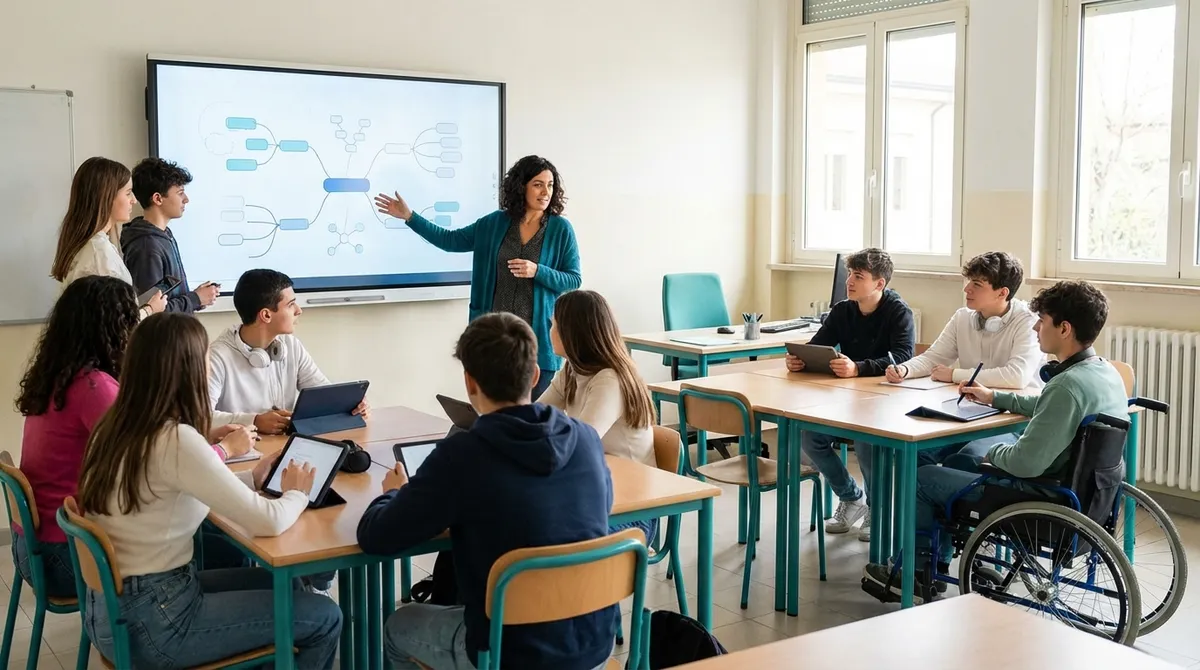
In 2026, talking aboutinclusive teachingin upper secondary school means designing lessons that truly enable everyone to learn: students with SLD and SEN, with disabilities, multilingual students, but also those going through periods of emotional vulnerability or who have very different cognitive styles. The good news is thateducational technology— if used thoughtfully — can lighten teachers’ workload and improve the quality of the classroom experience. Tools likeStudierAIhelp transform materials and activities into more accessible resources, supporting alesson personalizationconsistent with shared goals and transparent criteria. If you want to experiment in a guided way, you can alsostart for freeand build a first replicable workflow.
Why inclusive teaching is a priority in upper secondary schools in 2026
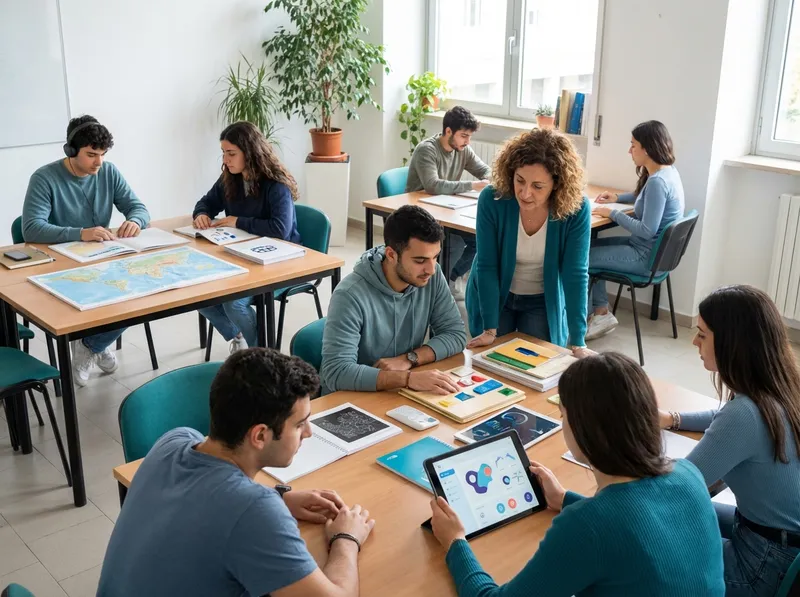
Upper secondary school classes are increasingly heterogeneous: profiles withSEN,SLD, certified disabilities, students with a migrant background and different language skills are increasing, along with gaps in motivation and prerequisites. In this scenario, inclusion cannot be reduced to occasional “fixes”: it works when it becomesintentional design, that is, a teaching choice that anticipates obstacles and builds multiple ways to learn and demonstrate competence from the very beginning.
In 2026, complexity also increases: dense curricula, frequent assessments, large classes, and growing pressure on wellbeing. Inclusive teaching therefore becomes a strategy for effectiveness, not only for equity: when instructions are clear, materials accessible, and feedback timely, attention, autonomy, and results improve for the whole class group. The goal is to move from a “one size fits all” model to a model of “shared goals, flexible pathways.”
Operational principles of inclusion: from universal design to personalization

To make inclusive teaching operational, three levers are particularly effective when integrated with one another:UDL (Universal Design for Learning),differentiationandformative assessment. UDL encourages planning in advance multiple modes of access (text, audio, visual), participation (choices, collaboration, timing), and expression (different ways to show what you know). Differentiation makes it possible to vary the path without changing the destination: same objectives, but activities with different levels of support or complexity. Formative assessment, finally, makes learning visible as it happens, so you can adjust course before the final test.
In practice, this means clearly defining:objectives(what the student must be able to do),criteria(how I assess) andconstraints(time, tools, prerequisites). Then offering options: for example, a text with a glossary and a simplified version; an assignment with examples; a shared rubric; and micro-checkpoints to verify understanding. Inclusion here is not “doing more” but “doing better,” reducing cognitive noise and increasing the quality of instructions.
- Access: materials in different formats (text, outline, audio) and controlled language.
- Participation: choices about roles, timing, tools; structured cooperative learning.
- Expression: alternatives to oral questioning only (presentation, map, authentic task) with a common rubric.
How StudierAI can support inclusive and personalized teaching

In everyday practice, the bottleneck is time: preparing variants, supports, and assessments takes energy. This is whereinclusive artificial intelligencecomes into play: it does not “replace” teaching, but speeds up the production of materials and makes it easier to experiment. In particular,StudierAI for upper secondary schoolcan support various useful actions from an inclusive perspective, while keeping the teacher’s guidance central. To learn more about the project you can visitStudierAIand theabout uspage.
Here are some concrete use cases, immediately applicable:
- Simplification and controlled rewriting: create a “basic” version of the text (shorter sentences, more frequent vocabulary) and an “advanced” version for those who can go deeper, without changing the key concepts.
- Concept maps and outlines: extract nodes, relationships, and keywords to support working memory and independent study (useful for SLD and for those studying in L2).
- Difficulty levels: generate graded exercises (A/B/C) on the same objective, with progressive hints and explicit success criteria.
- Language supports: bilingual glossaries, explanations for difficult words, usage examples, paraphrases. Great for multilingual students and for making subject-specific texts more accessible.
- Adaptive and formative assessments: sets of questions to check understanding (multiple choice, justified true/false, step-by-step questions), with immediate feedback and indications of what to review.
Responsible integration, however, requires some choices: define what AI can do (drafts, variants, examples) and what remains human (teaching decisions, final assessment, relationship). In addition, it is useful to maketransparentto students the criteria for use: when it is allowed, how to cite, how to verify. In this way, educational technology also becomes education for digital citizenship.
Practical workflow to integrate StudierAI into lessons: before, during, and after
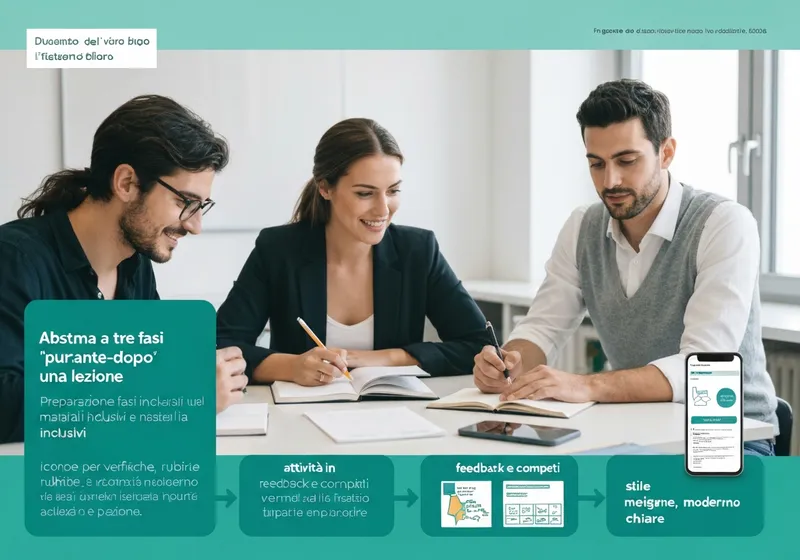
A simple, replicable process helps you avoid “adding tools” and instead improve the routine. You can start with a single teaching unit and then scale up. If you don’t have an account yet, you cansign up for freeand prepare the first materials in just a few minutes.
Before the lesson (20–30 minutes):
- Needs analysis: identify 2–3 likely barriers (vocabulary, reading load, long instructions, performance anxiety).
- Materials preparation: generate a summary, a concept map, and two versions of the text (basic/standard). Also prepare an essential glossary (10 words).
- Formative assessment: create 5 “checkpoint” questions to verify understanding halfway through the lesson.
During the lesson (50–60 minutes):
Open with a short, visible instruction (objective + success criterion). Immediately offer the choice: standard or basic text, plus the map. Alternate micro-explanations with guided activities: for example, “complete the map with three missing concepts” or “write a concrete example of concept X.” Halfway through, use the checkpoints to understand who is struggling and adjust: one group works with hints, another goes deeper with a challenging question. This is the heart of lesson personalization without fragmenting the class.
After the lesson (10–15 minutes):
- Homework: assign a task with controlled choice (e.g., guided summary, flashcards, short audio explanation) with a common rubric.
- Feedback: prepare template comments on frequent errors and recovery suggestions; personalize only where it’s truly needed.
This workflow reduces “improvised” variability and frees up time: instead of creating from scratch, you refine and decide. The result is a more manageable class and more autonomous students.
Assessing impact and managing critical issues: equity, privacy, transparency, and cognitive load

To understand whether innovation works, you need to measure in a light but consistent way. Some useful metrics (also qualitative) are: participation (who contributes and in what ways), homework completion, checkpoint outcomes, quality of productions against the rubric, and perceived self-efficacy (short exit tickets). Compare data over time and not only between students: inclusion looks at progress, not the average.
Alongside the benefits, there are critical issues to manage with clear guidelines:
- Equity and bias: check that examples, texts, and questions do not reinforce stereotypes; do a teacher review before assigning.
- Privacy: avoid entering sensitive data; use anonymized content and get informed about the school’s policies and settings.
- Transparency: explain to students when AI was used to create materials and what the expectations are (e.g., cite, rework, verify).
- Cognitive load: don’t multiply options without guidance; a few choices, well explained, and stable routines (always the same assignment structure and rubric).
Finally, take care of communication with families and students: clarify that educational technology is a support for learning, not a “trick” to do less. Share examples of accessible materials, rubrics, and shared goals. When the school community understands the why, innovation becomes sustainable and inclusive teaching stops being an emergency: it becomes a method.
