

In 2026, managingwork groupsis no longer an “extra” organizational add-on: it’s a teaching lever that affects learning, classroom climate, and inclusion. The good news is thatartificial intelligencecan help teachers make fairer decisions that are more consistent with their goals, without turning the lesson into a logistics exercise. In this article we look at practical criteria and a possible use ofStudierAIforpersonalizationof groups dynamically and to improvestudent collaborationin a sustainable way.
Why group composition has become a key teaching skill in 2026
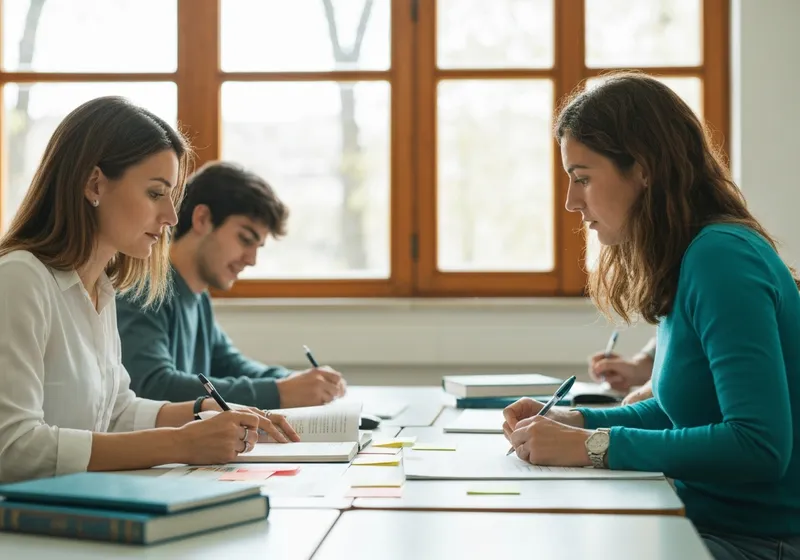
Group composition today is closely tied to three priorities:learning objectives, the development oftransversal skills(communication, leadership, negotiation, time management), andinclusion. In many classes, moreover, the variability of levels and needs has increased: students on different pathways, intermittent absences, new emotional vulnerabilities, and a more intensive use of project-based activities. In this context, “putting four students together at random” is not neutral: it can amplify inequalities, create dependencies (one person does everything), or generate avoidable conflicts.
Traditional methods have well-known limits. Choosing “by friendship” increases comfort but often reduces the quality of discussion; choosing “by level” can be useful in some phases, but risks labels and demotivation; random rotation is quick, but it doesn’t take objectives, roles, and availability into account. The point is not to find a perfect criterion, but to develop a skill:designing groups that are coherent with the activityand updating them when data and conditions change (attendance, progress, relational dynamics).
Effective criteria for forming work groups: skills, learning styles, and availability
An effective group is born from the intersection of teaching criteria and real-world constraints. In practice, it helps to think through three questions:what they have to produce,how they have to workandin how much time. From there come choices about heterogeneity/homogeneity, roles, and availability.
- Heterogeneity vs homogeneity: heterogeneous groups work well for problem solving, authentic tasks, and peer tutoring; homogeneous groups are useful for targeted remediation, practice on prerequisites, or similar working speeds.
- Skills and levels: not just “good/not good,” but micro-skills (writing, calculation, source research, oral presentation, critical thinking). A balanced group reduces the risk that a single skill becomes a bottleneck.
- Roles and responsibilities: assign (and rotate) roles such as facilitator, timekeeper, scribe, spokesperson. Roles make participation observable and improve equity.
- Styles and preferences (with caution): alternating more reflective students with those who are quicker in interaction can increase the quality of reasoning. Avoid, however, “crystallizing” labels: better to use stated preferences for the activity (e.g., public speaking yes/no) and provide opportunities for gradual growth.
- Availability and logistics: absences, deadlines, tools (PC/tablet), space constraints, need for support. A “perfect” group on paper fails if it can’t meet or if a key device is missing.
Balancing these criteria also means accepting trade-offs. One operational suggestion: for each activity choose2 priority criteria(e.g., heterogeneity of skills + availability) and 1 “control” criterion (e.g., avoid known conflicting pairs). This way group formation remains manageable and transparent for the class.
StudierAI for dynamic group personalization: how it works and what it optimizes
The promise of personalization is not to “automate” the teacher, but toreduce the decision-making loadand make choices more consistent. WithStudierAIthe idea is to use instructional and logistical data (even minimal) to propose group configurations that maximize the quality of collaboration and the likelihood of achieving the activity’s objective.
Concretely, a “dynamic” approach can optimize multiple dimensions at the same time, for example:balance of skills, role distribution, rotation of interactions (to prevent the same students from always working together), management of constraints (absences, need for support), and inclusion goals (avoid isolation, encourage participation).
An important point for teachers: the AI’s proposal must remainexplainable and editable. The value is not only “the final group,” but the ability to see which criteria are guiding the composition and to intervene with professional common sense (for example, separating a pair that today can’t work together, or protecting a student in an emotionally delicate phase).
If you want to explore the approach without complications, you canstart for freeand assess whether the grouping proposals reflect your priorities. To understand the educational philosophy and the project context, you can also find the pageabout us.
Classroom implementation: practical workflow, rules of engagement, and assessment of group work
To make group personalization truly useful, you need a simple workflow that is repeatable and communicable to students. Below is a “before/during/after” structure that works well both with stable groups and with groups that change with each unit.
Before (10–15 minutes of planning): define the expected outcome and the priority criteria. Then prepare a minimal data set: level or competency indicators for the unit, any preferences (e.g., “I prefer writing/speaking”), constraints (planned absences, tools). If you use support such asStudierAI, request a group proposal and do a human check: 1) consistency with the criteria, 2) any known relational criticalities, 3) role distribution.
During (routines and rules of engagement): make explicit what “collaborating” means in that activity. Three rules that are often decisive:positive interdependence(everyone is necessary),individual accountability(individual traces), androle rotation. Add short checkpoints: halfway through the activity each group submits a “traffic light” (green/yellow/red) on progress and one question for the teacher. This reduces conflicts and stalls without micro-management.
- Prevent free-riding: require an individually traceable contribution (draft, calculations, sources, concept map) and a brief final self-assessment.
- Manage conflicts: use discussion protocols (turn-taking, paraphrasing, criteria-based decision) and provide a “reset clause” (5 minutes to renegotiate roles and plan).
- Monitor without intruding: brief observations with a grid (participation, listening, use of time, argumentative quality) and immediate feedback on just one aspect at a time.
After (assessment and improvement): assess both the product and the process. An essential rubric can include: quality of the work, use of evidence, communicative clarity, work management, and individual contribution. Close with 3 minutes of retrospective: “what worked,” “what we change,” “which collaboration skill we train next time.” This is where personalization becomes dynamic: the retrospective data (even just teacher notes) guide the next groups.
In summary:work groupsbecome more effective when they are designed, explained, and reviewed. Tools based onartificial intelligencecan support this skill, especially when the class is complex and time is short. If you want to try a guided approach to group composition and personalization, you can alsosign up for freeand start with a short activity: one task only, clear criteria, explicit roles, and a final retrospective. It’s often enough to see immediate improvements in student collaboration.
