In 2026, the debate about exams and AI is no longer just about “catching who cheats,” but about how to design assessments that truly measure skills, reasoning, and decision-making. In particular,university oral examsbecome a delicate terrain: on the one hand they are perceived as more “secure” than written exams, on the other AI enables new forms of invisible assistance and, at the same time, increases the risk of false positives if one relies on proctoring and unreliable behavioral signals.
This article offers an operational angle for instructors: what changes withoff-campus AI, which risks are realistic in oral exams, and how to rethink prompts, questions, and rubrics from the perspective ofacademic integrityandauthentic assessment. The goal is not to make the exam more rigid, but to make it fairer, more transparent, and more informative for learning.
Why in 2026 proctoring is no longer enough (and what changes with off-campus AI)
Theproctoring 2026has entered a phase of “diminishing returns”: more controls do not automatically equal more integrity. AI available outside the classroom (and often outside the university’s technical perimeter) allows students to prepare answers, outlines, and even conversational strategies in advance, reducing the need to consult sources during the assessment. In parallel, in online or hybrid contexts, real-time support tools can be used without leaving obvious traces on webcam or screen sharing.
The pedagogical point is that the challenge shifts from surveillance toassessment designand evaluation criteria. If the exam mainly measures the ability to reproduce content (definitions, summaries, standard procedures), AI makes that performance more accessible and less diagnostic. If instead the exam measures the ability to choose, argue, justify, and adapt knowledge to specific constraints, then AI can become a legitimate study tool without hollowing out the assessment.
In terms of pedagogical evidence, two principles remain solid even in the new scenario: (1) assessment is more reliable when it observesprocessesin addition to outputs; (2) authentic tasks and explicit criteria reduce ambiguity and conflict, improving both fairness and the quality of feedback. In other words: not “more cameras,” but “better prompts, better questions, better rubrics.”
University oral exams with AI: real risks, false positives, and new vulnerabilities
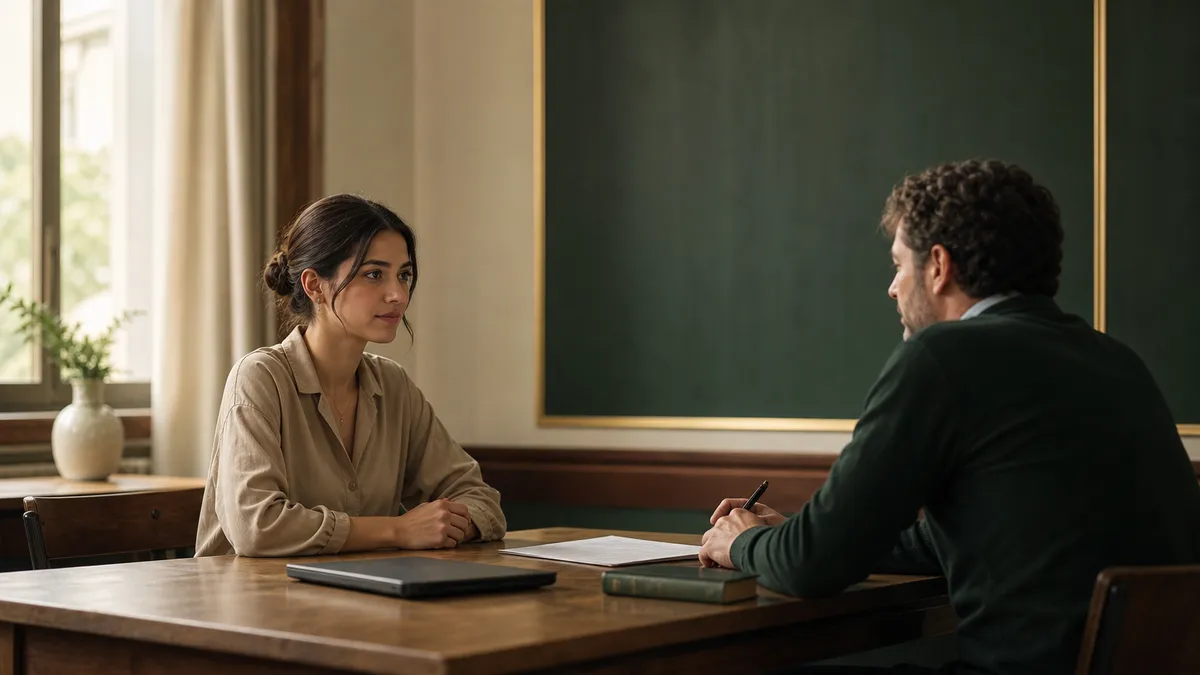
Oral exams are often considered an antidote toAI-enabled assessmentsbecause they include interaction, improvisation, and identity checks. However, AI introduces three families of risks, especially when the exam is online or when the student is in an uncontrolled environment.
- Scripts and “prefabricated answers”: the student can show up with very well-crafted scripts (also customized to the course syllabus) and train on possible questions, reducing the variability of oral performance.
- Real-time coaching: in remote contexts, an assistant (human or AI) can suggest micro-cues via earbuds, a second device, or channels that are hard to detect with traditional proctoring.
- Deepfakes and voice cloning: these are less frequent scenarios, but growing. They do not always aim to “replace” the student; more often they serve to mask hesitation, read suggestions, or simulate communicative confidence.
One last point: when students have access to a well-guided study pathway, the incentive to look for shortcuts during the exam decreases. In this sense, AI is not only a risk, but also an opportunity to improve the quality ofAI-enabled assessmentsand align them with an evaluation that rewards understanding, transfer, and responsibility.
For instructors, the practical consequence is twofold: (1) avoid basing grading decisions on weak signals; (2) build an exam that makesIf you want to explore the approach in an operational way, you canstart for free
or
“AI-resilient” does not mean “AI-proof” (unrealistic), but designed to maintain validity and reliability even if the student uses support tools. A practical framework for instructors can be based on three levers:sign up for freeand test oral-exam simulations and study pathways consistent with authentic assessment. The goal is not to “beat” proctoring, but to reduce dependence on proctoring through more robust assessments and a more transparent study method.who we are.reasoning-oriented rubricsIn summary: in proctoring 2026, control technology alone cannot keep up with the evolution of off-campus AI. The most effective response for instructors is a combination of “AI-resilient” design, reasoning-centered rubrics, process traces, and a fair protocol for prevention and disputes. This way AI stops being only a threat and becomes a context within which to design better assessments.
From a teaching perspective, the most relevant contribution is the possibility of structuring practice and simulations that make reasoning explicit. In preparation oriented towarduniversity oral exams, for example, the student can train on tiered questions, receive requests for clarification, and learn to handle objections and variants. For the instructor, this means being able to suggest a study method consistent with the rubric: not just “study more,” but “study by showing how you make decisions and how you check your steps.”defendFrom a transparency standpoint, guided preparation tools can help keep traces of the pathway: successive versions of an answer, rationales for choices, points of uncertainty, and sources consulted. This type of material is also useful for assessment: not as “forensic proof,” but as support for an academic conversation about the process. It is a concrete way to make the
2) Process traceability: ask for light but meaningful evidence. There is no need to turn the exam into an audit; it is enough to require “traces” that make the study pathway plausible. For example: a personal concept map, a set of commented exercises, a short decision diary (“I chose this hypothesis because…”), or an annotated bibliography. These traces supportacademic integrityas a formative practice, not just a punitive rule.
3) Reasoning-oriented rubrics: an effective rubric for oral exams in the AI era clearly separates: disciplinary knowledge, quality of argumentation, handling of objections, ability to transfer, and metacognition (awareness of limits and alternatives). In practice, explicitly assess: “how you arrive at the answer” and “what you would do if…”. This also reduces anxiety: the student knows what counts and does not interpret every hesitation as a failure.
A often-overlooked measure: design part of the oral exam as a “local comprehension check.” 2–3 micro-questions on a specific step in the reasoning are enough (“why do you choose this definition here?”, “which condition makes this step valid?”). AI is good at producing globally plausible answers; it is less robust when it has to sustain coherence on details and constraints specific to your course.
Operational protocol for instructors: before, during, and after the exam (in person and online)

A clear protocol reduces risks and, above all, reduces perceived arbitrariness. Below is an essential checklist, adaptable to different disciplines and student numbers. The idea is to combine prevention, transparency, and proper handling of disputes.
- Before the exam: publish a short policy on permitted/non-permitted use of AI tools (e.g., preparation allowed, real-time support during the oral exam prohibited), with concrete examples and pedagogical rationale.
- Before the exam: do a briefing on criteria and rubric (even 10 minutes in class or a document). Transparency is an equity intervention, not a “gift.”
- Before the exam: prepare a set of tiered questions (basic, application, transfer) and a share of “variant” questions for randomization. You don’t need to be unpredictable: you need to be comparable.
- During the in-person exam: ask the student to work on a sheet of paper (or the board) for 2–3 key steps. The “real-time” production of reasoning is strong and minimally invasive evidence.
- During the online exam: define realistic minimum requirements (front-facing camera, microphone, quiet environment) and provide alternatives in case of technical problems. Avoid turning connectivity into a merit criterion.
- During the exam (always): include 1–2 reasoning “stress test” questions (constraint change, counterexample, request to explain a common mistake). This is where authentic mastery emerges.
- After the exam: briefly note observable evidence tied to the rubric (not generic impressions). This helps feedback, consistency across panels, and handling of any appeals.
For handling disputes, one prudent rule: if you suspect illicit support, avoid decisions based on “signals” (gaze, fluency, latency). Instead, look for verifiable inconsistencies: inability to explain steps, contradictions between preparatory materials and performance, inability to apply concepts to minimal variants. This approach is more defensible and more respectful of honest students.
start for free

orsign up for freeand test oral-exam simulations and study pathways consistent with authentic assessment. The goal is not to “beat” proctoring, but to reduce dependence on proctoring through more robust assessments and a more transparent study method.who we are.
From a teaching perspective, the most relevant contribution is the possibility of structuring practice and simulations that make reasoning explicit. In preparation oriented towarduniversity oral exams, for example, the student can train on tiered questions, receive requests for clarification, and learn to handle objections and variants. For the instructor, this means being able to suggest a study method consistent with the rubric: not just “study more,” but “study by showing how you make decisions and how you check your steps.”
From a transparency standpoint, guided preparation tools can help keep traces of the pathway: successive versions of an answer, rationales for choices, points of uncertainty, and sources consulted. This type of material is also useful for assessment: not as “forensic proof,” but as support for an academic conversation about the process. It is a concrete way to make theacademic integrityas a formative practice, not just a punitive rule.
One last point: when students have access to a well-guided study pathway, the incentive to look for shortcuts during the exam decreases. In this sense, AI is not only a risk, but also an opportunity to improve the quality ofAI-enabled assessmentsand align them with an evaluation that rewards understanding, transfer, and responsibility.
If you want to explore the approach in an operational way, you canstart for freeorsign up for freeand test oral-exam simulations and study pathways consistent with authentic assessment. The goal is not to “beat” proctoring, but to reduce dependence on proctoring through more robust assessments and a more transparent study method.
In summary: in proctoring 2026, control technology alone cannot keep up with the evolution of off-campus AI. The most effective response for instructors is a combination of “AI-resilient” design, reasoning-centered rubrics, process traces, and a fair protocol for prevention and disputes. This way AI stops being only a threat and becomes a context within which to design better assessments.